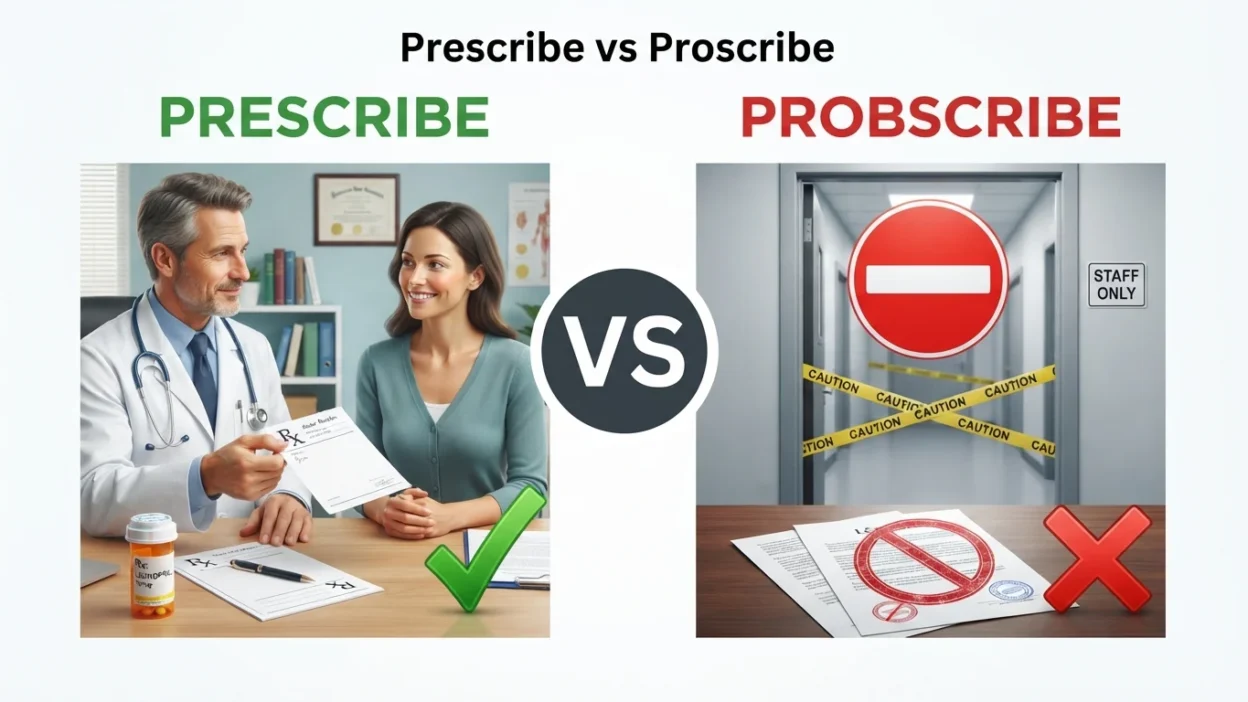
The prescribe vs proscribe comparison confuses many English learners because the two words look and sound similar but have nearly opposite meanings.
While prescribe means to recommend, authorize, or officially order something, proscribe means to forbid, prohibit, or outlaw it. Mixing them up can completely change the meaning of a sentence.
Understanding prescribe vs proscribe is essential for clear communication in medicine, law, business, education, and everyday writing.
This guide explains the meaning of each word, highlights their differences, provides real-world examples, grammar forms, memory tricks, and common mistakes so you can confidently choose the correct word every time.
Quick Answer
Prescribe means to recommend, authorize, or order something, especially medicine or rules.
Proscribe means to prohibit, ban, or officially forbid something.
Remember: Prescribe = Recommend. Proscribe = Prohibit.
Prescribe vs Proscribe Comparison Table
| Feature | Prescribe | Proscribe |
|---|---|---|
| Meaning | Recommend or authorize | Ban or forbid |
| Common Context | Medicine, rules | Law, government, policies |
| Tone | Positive or instructional | Restrictive or negative |
| Part of Speech | Verb | Verb |
| Opposite Idea | Recommend | Prohibit |
What Does Prescribe Mean?
Prescribe means to officially recommend, authorize, or direct someone to do or use something.
It is most commonly used when doctors prescribe medicine, but it can also refer to rules, procedures, or standards.
Examples
- The doctor prescribed antibiotics.
- The teacher prescribed extra reading.
- Company policy prescribes safety procedures.
- The law prescribes specific penalties.
What Does Proscribe Mean?
Proscribe means to officially forbid, ban, or prohibit something.
It is commonly used in legal, political, and regulatory contexts.
Examples
- The government proscribed the organization.
- School rules proscribe bullying.
- The policy proscribes discrimination.
- Certain chemicals are proscribed by law.
Main Difference Between Prescribe and Proscribe
| Point | Prescribe | Proscribe |
|---|---|---|
| Basic Meaning | Recommend | Ban |
| Action | Tell someone to do something | Tell someone not to do something |
| Medical Use | Very common | Rare |
| Legal Use | Rules or penalties | Bans or prohibitions |
| Overall Idea | Permission or instruction | Restriction |
A simple way to remember:
Prescribe = Tell people what they should do.
Proscribe = Tell people what they cannot do.
When Should You Use Prescribe?
Use prescribe when someone officially recommends or orders an action.
Common situations
- Doctors prescribing medication
- Teachers assigning work
- Policies establishing procedures
- Laws specifying penalties
Examples
- The physician prescribed pain medication.
- The manual prescribes maintenance procedures.
- The contract prescribes payment terms.
- The instructor prescribed weekly assignments.
When Should You Use Proscribe?
Use proscribe when something is officially forbidden or banned.
Common situations
- Government bans
- School regulations
- Company policies
- International sanctions
Examples
- The law proscribes bribery.
- The organization proscribed unsafe practices.
- Company rules proscribe workplace harassment.
- The treaty proscribes chemical weapons.
Grammar Forms
| Form | Prescribe | Proscribe |
|---|---|---|
| Base Verb | Prescribe | Proscribe |
| Third Person | Prescribes | Proscribes |
| Present Participle | Prescribing | Proscribing |
| Past Tense | Prescribed | Proscribed |
| Past Participle | Prescribed | Proscribed |
| Noun | Prescription | Proscription |
| Adjective | Prescriptive | Proscriptive |
Real-Life Examples
Business
| Situation | Correct Word |
|---|---|
| Company handbook gives procedures | Prescribe |
| Company bans insider trading | Proscribe |
Example:
The employee handbook prescribes ethical behavior while company policies proscribe fraud.
Education
Teachers prescribe assignments, while schools may proscribe cheating.
Example:
The professor prescribed additional reading.
The university proscribes plagiarism.
Healthcare
Doctors prescribe treatments.
Hospitals may proscribe unsafe medical practices.
Example:
The surgeon prescribed physical therapy after surgery.
Law
Laws may prescribe penalties and proscribe illegal activities.
Example:
The law prescribes a fine for speeding and proscribes reckless driving.
Science
Research guidelines prescribe proper procedures and proscribe unethical experiments.
Professional Usage Table
| Industry | Prescribe | Proscribe |
|---|---|---|
| Healthcare | Medications | Unsafe treatments |
| Law | Legal procedures | Illegal acts |
| Business | Company guidelines | Fraudulent behavior |
| Education | Coursework | Academic dishonesty |
| Government | Regulations | Banned organizations |
| Science | Research methods | Unsafe practices |
Why Do People Confuse Prescribe and Proscribe?
The confusion happens because:
- Both begin with “pr”.
- They differ by only one letter.
- Both are formal English words.
- Both often appear in legal or official writing.
- Their pronunciation is similar.
However, their meanings are almost opposites.
Memory Tricks
| Word | Memory Trick |
|---|---|
| Prescribe | Pre = Provide something helpful, like medicine. |
| Proscribe | Pro = Prohibit something by banning it. |
Easy shortcut:
Prescribe = Prescription
Proscribe = Prohibition
Common Mistakes
| Incorrect Sentence | Correct Sentence |
|---|---|
| The doctor proscribed antibiotics. | The doctor prescribed antibiotics. |
| The government prescribed terrorism. | The government proscribed terrorism. |
| School rules prescribe cheating. | School rules proscribe cheating. |
| The physician proscribed pain medicine. | The physician prescribed pain medicine. |
| The law prescribed illegal gambling. | The law proscribed illegal gambling. |
Process for Choosing the Correct Word
| Question | Choose |
|---|---|
| Is someone recommending or ordering something? | Prescribe |
| Is something being banned? | Proscribe |
| Is it about medicine? | Prescribe |
| Is it about legal prohibition? | Proscribe |
| Is it a company policy against something? | Usually Proscribe |
Sentence Examples Comparing Both Words
| Situation | Correct Sentence |
|---|---|
| Doctor | The doctor prescribed antibiotics. |
| Government | The government proscribed the extremist group. |
| School | Teachers prescribe homework. |
| Workplace | Company policies proscribe harassment. |
| Law | The statute prescribes penalties and proscribes corruption. |
| Research | Guidelines prescribe methods and proscribe misconduct. |
Tips to Avoid Confusing Prescribe and Proscribe
- Associate prescribe with prescription.
- Associate proscribe with prohibit.
- Think about whether something is being recommended or banned.
- Check the context before choosing the word.
- Practice using both words in sentences.
Frequently Asked Questions
Are prescribe and proscribe opposites?
They are close to opposites. Prescribe recommends or authorizes, while proscribe forbids or bans.
Which word is used by doctors?
Doctors use prescribe when recommending medicine or treatment.
Is proscribe the same as prohibit?
Yes. Proscribe means to officially prohibit or ban something.
Can laws prescribe and proscribe?
Yes. Laws can prescribe penalties or procedures while also proscribing illegal activities.
Which word is more common?
Prescribe is much more common, especially in everyday English and healthcare.
Are both words verbs?
Yes. Both prescribe and proscribe are verbs with related noun and adjective forms.
Conclusion
The prescribe vs proscribe distinction is easy to remember once you focus on their meanings. Prescribe means to recommend, authorize, or officially direct an action, while proscribe means to ban, prohibit, or outlaw something.
If you’re discussing medicine, law, education, or business, using the correct word ensures your message is accurate and professional. A simple memory rule can help: prescriptions help, proscriptions prohibit.

Julian Wyatt is a passionate researcher and writer who explores symbols, mythology, cultural traditions, and hidden meanings. Through engaging articles, he helps readers uncover the fascinating stories and significance behind symbols worldwide.