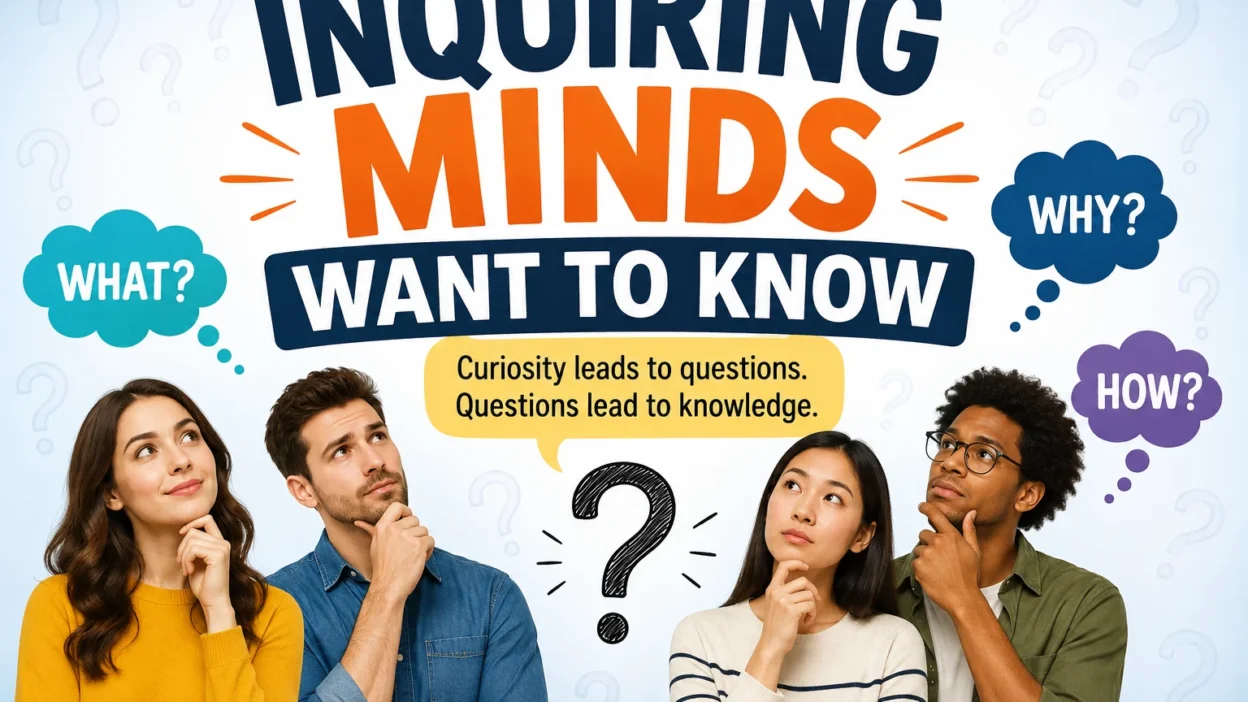
The phrase inquiring minds want to know is one of the most recognizable expressions in English. People often use it humorously or sincerely when they are curious about a topic, person, or event.
if you’re reading social media comments, watching television, or having a casual conversation, you’ve probably heard someone say inquiring minds want to know.
Many English learners also wonder about the meaning, usage, and origin of this phrase. Is it formal or informal? When should you use it? This guide explains everything about inquiring minds want to know, including examples, grammar, common mistakes, professional usage, and helpful memory tricks so you can use it naturally.
Quick Answer
“Inquiring minds want to know” means people are curious and want more information about something.
The phrase is usually used humorously or conversationally to ask for details, satisfy curiosity, or encourage someone to explain more.
What Does “Inquiring Minds Want to Know” Mean?
It is commonly used when someone wants an answer to an interesting question or wants another person to reveal more details.
Simple meanings
| Phrase | Meaning |
|---|---|
| Inquiring | Curious; asking questions |
| Minds | People who are thinking or curious |
| Want to know | Desire information |
Combined, the phrase means:
Curious people would like an answer.
Main Meaning Table
| Feature | Explanation |
|---|---|
| Phrase | Inquiring minds want to know |
| Type | Idiomatic expression |
| Tone | Informal, humorous, conversational |
| Purpose | Express curiosity |
| Common Use | Conversations, social media, interviews |
| Formality | Mostly informal |
Origin of “Inquiring Minds Want to Know”
The phrase became famous through advertising.
It gained widespread popularity in the 1980s because of advertisements for the supermarket tabloid National Enquirer, whose slogan was:
Although the expression existed earlier, the advertising campaign made it a common part of everyday English.
Today, people often use it jokingly whenever they are curious.
When Should You Use This Phrase?
You can use the phrase whenever you want someone to explain something or share information.
Common situations include:
- Asking about exciting news
- Wanting details about an event
- Responding to gossip
- Curious social media discussions
- Friendly conversations
- Interviews
- Classroom discussions
Examples
- Inquiring minds want to know—who won the competition?
- Inquiring minds want to know what happened yesterday.
- We saw your announcement. Inquiring minds want to know the full story.
- You can’t stop there. Inquiring minds want to know!
Grammar Breakdown
The phrase follows a simple sentence structure.
| Word | Part of Speech | Function |
|---|---|---|
| Inquiring | Adjective | Describes minds |
| Minds | Noun | Subject |
| Want | Verb | Main action |
| To know | Infinitive | Explains what they want |
Pattern:
Adjective + Noun + Verb + Infinitive
How Is It Different from Similar Expressions?
Several expressions communicate curiosity, but they are not exactly the same.
| Expression | Meaning | Tone |
|---|---|---|
| Inquiring minds want to know | People are curious | Humorous |
| I’m curious | Personal curiosity | Neutral |
| Tell me more | Request information | Friendly |
| What happened? | Direct question | Neutral |
| Everyone wants to know | General curiosity | Neutral |
Real-Life Examples
Business
A manager announces a surprise meeting.
Employee:
“Inquiring minds want to know what’s on the agenda.”
Education
Teacher:
“We have exciting news for next semester.”
Student:
“Inquiring minds want to know!”
Science
Scientists release new research.
Journalists write:
“Inquiring minds want to know how this discovery will affect medicine.”
Social Media
Friend:
“I have something huge to announce tomorrow.”
Comments:
- Inquiring minds want to know!
- Don’t leave us hanging!
- Tell us now!
Family
Mom:
“I have a surprise.”
Kids:
“Inquiring minds want to know!”
Professional vs Casual Usage
The phrase is flexible but works better in informal settings.
| Situation | Appropriate? |
|---|---|
| Friends | ✅ Yes |
| Family | ✅ Yes |
| Social media | ✅ Yes |
| Interviews | ✅ Yes |
| Presentations | ✅ Sometimes |
| Business emails | ⚠ Usually avoid |
| Academic writing | ❌ Not recommended |
Common Mistakes
Many learners misunderstand or misuse this phrase.
| Incorrect | Correct |
|---|---|
| Inquiring mind wants to know. | Inquiring minds want to know. |
| Inquiry minds want to know. | Inquiring minds want to know. |
| Inquiring minds wants to know. | Inquiring minds want to know. |
| Curious minds wants to know. | Curious minds want to know. |
Correct vs Incorrect Sentences
| Incorrect Sentence | Correct Sentence |
|---|---|
| Inquiring minds wants to know. | Inquiring minds want to know. |
| Inquiry minds want to know. | Inquiring minds want to know. |
| Inquiring mind want to know. | An inquiring mind wants to know. |
| Inquiring minds wanted know. | Inquiring minds want to know. |
Why Do People Confuse This Phrase?
Several reasons explain the confusion.
| Reason | Explanation |
|---|---|
| Similar words | Inquiry and inquiring look alike. |
| Singular vs plural | Mind and minds change the verb. |
| Grammar | Learners may use “wants” instead of “want.” |
| Informal use | People hear it more often than they read it. |
Memory Trick
Remember this easy rule:
Many curious people = many minds = want
Think:
Many minds → want
Not:
Many minds → wants
Another trick:
Imagine a crowd of curious reporters asking questions together.
That image helps you remember the correct phrase.
Where Is the Phrase Commonly Used?
| Industry | Example Usage |
|---|---|
| Journalism | Headlines and interviews |
| Marketing | Teaser campaigns |
| Television | Entertainment shows |
| Education | Classroom discussions |
| Customer service | Light-hearted communication |
| Social media | Comments and memes |
How to Use the Phrase Naturally
Follow these simple steps.
| Step | Action |
|---|---|
| 1 | Hear interesting news. |
| 2 | Become curious. |
| 3 | Say, “Inquiring minds want to know!” |
| 4 | Wait for the explanation. |
Synonyms and Similar Expressions
| Expression | Meaning |
|---|---|
| I’m curious | I want to know |
| Tell me more | Give additional information |
| Spill the details | Reveal everything |
| Don’t keep us guessing | Explain now |
| What’s the story? | What happened? |
| We need answers | We want information |
People Also Ask
Is “inquiring minds want to know” an idiom?
Yes. It is an idiomatic expression used to express curiosity in a natural, conversational way.
Is the phrase formal?
No. It is generally informal and often humorous.
Can I use it at work?
Yes, but mainly in casual conversations or friendly presentations. It is less suitable for formal business writing.
Why is it plural?
The phrase refers to many curious people (“minds”), so the verb is want, not wants.
Is it grammatically correct?
Yes. Inquiring minds want to know is grammatically correct and widely accepted.
Frequently Asked Questions
What does “inquiring minds want to know” mean?
It means that people are curious and would like more information.
Is the phrase still popular?
Yes. It is commonly used in conversations, social media, and entertainment.
Can I replace “inquiring” with “curious”?
Yes. “Curious minds want to know” is understandable, but inquiring minds want to know is the established expression.
Where did the phrase become famous?
It became widely recognized through the National Enquirer advertising slogan.
Is it acceptable in professional writing?
Usually not. It works best in informal communication unless used intentionally for a conversational tone.
Conclusion
The phrase inquiring minds want to know is a classic English expression that communicates curiosity in a friendly and often humorous way. It became famous through advertising but is now widely used in everyday conversation, social media, journalism, and entertainment.
Remember that the correct grammar is inquiring minds want to know, with the plural noun minds taking the verb want. By understanding its meaning, usage, examples, and common mistakes, you can confidently use this popular phrase in natural English conversations.

Julian Wyatt is a passionate researcher and writer who explores symbols, mythology, cultural traditions, and hidden meanings. Through engaging articles, he helps readers uncover the fascinating stories and significance behind symbols worldwide.