The comparison day off vs off day often confuses English learners because both expressions involve taking a break from normal activities.
However, they do not mean the same thing.
Understanding the difference between day off vs off day helps you communicate more naturally in both personal and professional situations.
Many people mistakenly use these phrases interchangeably, but each has a distinct meaning and usage.
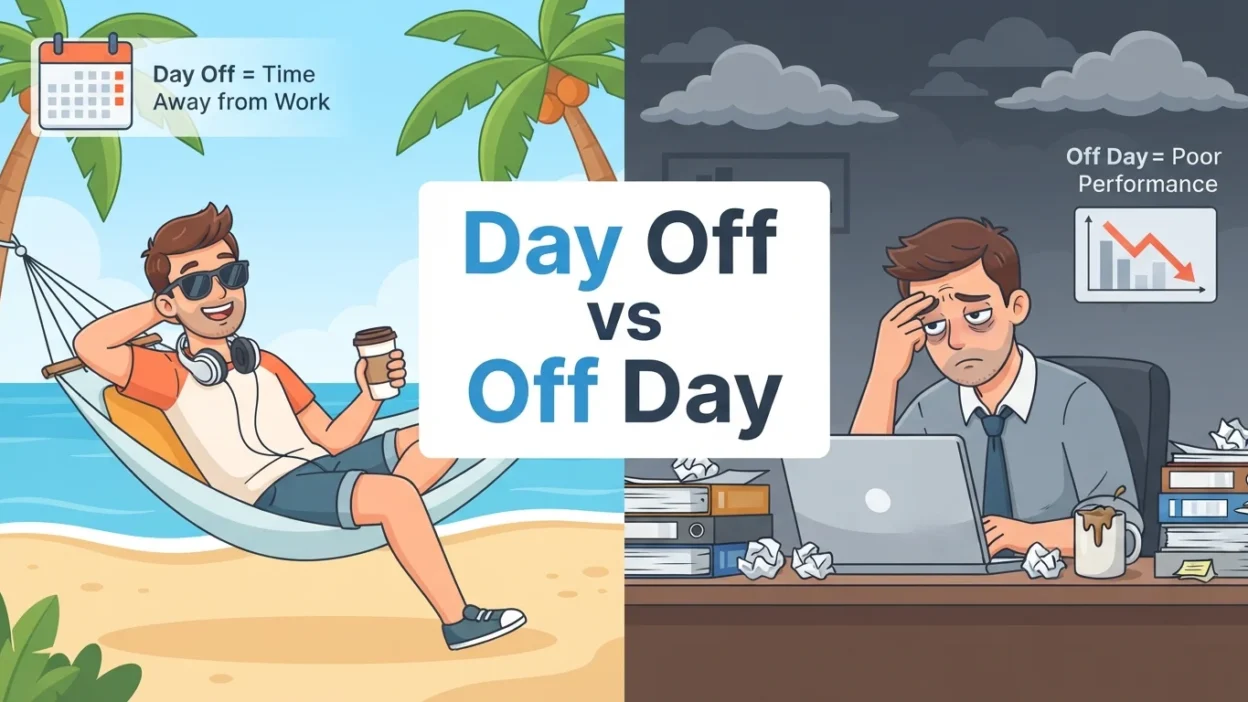
A day off refers to scheduled time away from work or responsibilities, while an off day usually describes a day when someone is not performing at their best.
This guide explains the day off vs off day difference with meanings, examples, grammar tips, tables, and common mistakes.
Quick Answer
A day off is a planned break from work, school, or regular duties.
An off day is a day when someone performs poorly or feels less productive than usual.
What Does “Day Off” Mean?
A day off is a scheduled or planned day when you do not work, attend school, or perform your regular duties.
Examples
- I have a day off tomorrow.
- She spent her day off with her family.
- Employees receive two days off every week.
Common Situations
| Situation | Example |
|---|---|
| Work | I’m taking a day off on Friday. |
| School | Students have a day off after exams. |
| Vacation | We enjoyed our day off at the beach. |
What Does “Off Day” Mean?
An off day refers to a day when someone is not performing as well as usual. It often describes athletes, workers, students, or anyone having an unusually poor performance.
Examples
- The pitcher had an off day.
- I’m having an off day and can’t concentrate.
- Everyone has an off day sometimes.
Day Off vs Off Day: Main Difference
| Feature | Day Off | Off Day |
|---|---|---|
| Meaning | A break from work or duties | A day of poor performance |
| Purpose | Rest and relaxation | Describes performance |
| Positive or Negative | Usually positive | Usually negative |
| Common Users | Employees, students | Athletes, professionals, anyone |
| Example | I took a day off. | I had an off day at work. |
When Should You Use “Day Off”?
Use day off whenever you mean time away from responsibilities.
Examples
- I requested a day off next Monday.
- Nurses rarely get consecutive days off.
- He used his day off to finish home repairs.
When Should You Use “Off Day”?
Use off day when talking about performance, mood, energy, or productivity.
Examples
- She had an off day during the presentation.
- The football team experienced an off day.
- Even great musicians have off days.
Grammar Forms
| Form | Example |
|---|---|
| a day off | I need a day off. |
| the day off | We enjoyed the day off. |
| days off | She gets weekends off. |
| an off day | Today is an off day. |
| off days | Athletes occasionally have off days. |
Real-Life Examples in Different Contexts
Business
- I requested a day off for a medical appointment.
- Our manager understood I was having an off day.
Education
- Students enjoyed a day off after the sports event.
- He had an off day during his math exam.
Sports
- The team had a day off between matches.
- The goalkeeper had an off day and made several mistakes.
Healthcare
- Doctors also need a day off to recharge.
- Even experienced surgeons can have an off day, though safety systems help prevent errors.
Daily Life
- We spent our day off hiking.
- I’m having an off day, so I’m taking things slowly.
Why Do People Confuse Day Off vs Off Day?
The confusion happens because both phrases include the word off.
However, the meanings are completely different.
- Day off = free from work.
- Off day = below normal performance.
Remember that one describes your schedule, while the other describes your condition.
Industry Usage
| Industry | Day Off | Off Day |
|---|---|---|
| Corporate | Vacation leave | Low productivity |
| Sports | Rest between games | Poor performance |
| Education | School holiday | Weak academic performance |
| Healthcare | Scheduled leave | Fatigue affecting performance |
| Retail | Weekly holiday | Unusually slow workday |
Memory Trick
A simple way to remember the difference:
| Phrase | Memory Tip |
|---|---|
| Day Off | You’re off from work. |
| Off Day | Your performance is off. |
Think about what is “off.”
- If work is off, it’s a day off.
- If your performance is off, it’s an off day.
Common Mistakes
Many learners accidentally replace one phrase with the other.
| Incorrect | Correct |
|---|---|
| I had an off day yesterday because it was a holiday. | I had a day off yesterday because it was a holiday. |
| She took an off day from work. | She took a day off from work. |
| The tennis player took a day off during the match. | The tennis player had an off day during the match. |
| Today is my off day from the office. | Today is my day off from the office. |
Correct vs Incorrect Sentences
Correct
- I have a day off tomorrow.
- She had an off day during the competition.
- We enjoyed our day off together.
- Everyone experiences an off day occasionally.
Incorrect
- I have an off day tomorrow from work.
- She took a day off during the tournament because she played badly.
Comparison Table with Examples
| Sentence | Correct Phrase | Why |
|---|---|---|
| I’m not working today. | Day off | Refers to leave from work |
| I couldn’t focus today. | Off day | Refers to poor performance |
| The office is closed for me today. | Day off | Scheduled break |
| The singer wasn’t at her best tonight. | Off day | Performance issue |
How to Choose the Right Phrase
| Question | Use |
|---|---|
| Are you talking about leave from work? | Day off |
| Are you talking about poor performance? | Off day |
| Is it a scheduled holiday? | Day off |
| Is someone unusually unproductive? | Off day |
People Also Ask
Is “day off” and “off day” the same?
No. A day off means time away from work, while an off day means someone is not performing well.
Can I say “I’m having a day off”?
Yes, if you mean you are taking leave from work. If you mean you’re not feeling productive, say I’m having an off day.
Is “off day” grammatically correct?
Yes. It is a common English expression describing below-average performance or mood.
Can athletes have an off day?
Yes. Sports commentators frequently use off day when an athlete performs below their usual level.
Can I use “day off” for school?
Yes. Students can have a day off when classes are canceled or during holidays.
FAQs
What is the main difference between day off vs off day?
A day off is scheduled time away from work or school, while an off day means someone is not performing normally.
Which phrase is more common in workplaces?
Day off is more common when discussing leave, vacations, or weekends.
Is an off day always negative?
Generally yes. It suggests lower-than-usual performance, although everyone experiences one occasionally.
Can both phrases appear in the same sentence?
Yes. Example: I took a day off because I was having an off day.
Which phrase should English learners remember first?
Learn day off for leave from work and off day for poor performance. This simple rule prevents most mistakes.
Conclusion
Understanding day off vs off day is easy once you know what each phrase describes. A day off refers to scheduled time away from work, school, or regular responsibilities. An off day, on the other hand, describes a day when someone is not performing, feeling, or functioning as well as usual.
Remember this simple rule: if you’re talking about time away from work, use day off. If you’re talking about performance being below normal, use off day. Using the correct expression will make your English sound more accurate, natural, and professional.