The debate over who else vs whom else is one of the most common grammar questions in English.
Many native and non-native speakers hesitate before choosing between these two expressions because modern English often favors who, while formal grammar sometimes requires whom.
Understanding who else vs whom else helps you write more confidently in emails, academic papers, and professional communication.
If you’ve ever wondered if to say “Who else is coming?” or “Whom else should I invite?”, you’re not alone.
This guide explains the meaning, difference, usage, grammar rules, examples, and common mistakes so you can always choose the correct form naturally.
Quick Answer
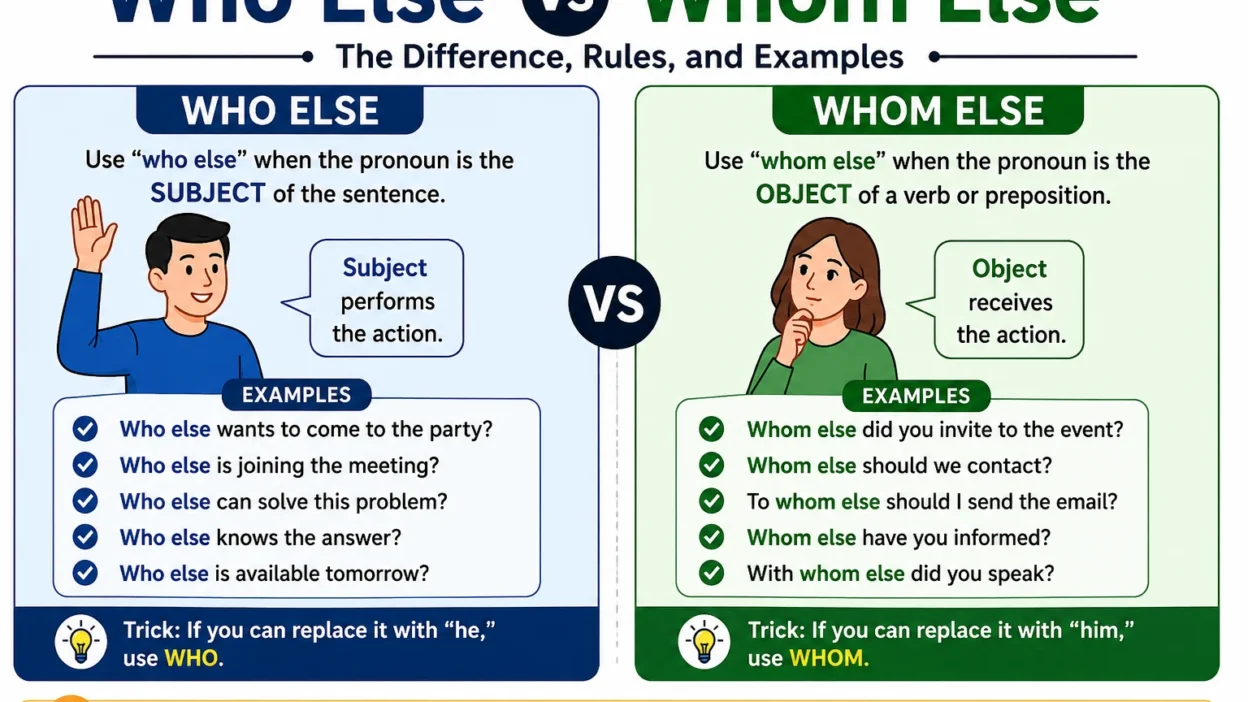
Who else is used when the pronoun is the subject of a sentence.
Whom else is used when the pronoun is the object of a verb or preposition.
In modern spoken English, who else is much more common, while whom else mainly appears in formal writing.
Who Else vs Whom Else Comparison Table
| Feature | Who Else | Whom Else |
|---|---|---|
| Part of speech | Subject pronoun | Object pronoun |
| Grammar role | Performs the action | Receives the action |
| Common in speech | Very common | Rare |
| Common in formal writing | Yes | Yes, when grammatically correct |
| Modern English | Preferred | Mostly formal |
| Example | Who else wants pizza? | Whom else did you invite? |
What Does “Who Else” Mean?
Who else refers to another person who performs an action or is being identified.
It asks about additional people beyond those already mentioned.
Examples
- Who else wants coffee?
- Who else can solve this problem?
- Who else attended the meeting?
- Who else is available tomorrow?
- Who else knows the answer?
Here, who functions as the subject.
What Does “Whom Else” Mean?
Whom else refers to another person receiving an action.
It functions as the object of a verb or a preposition.
Examples
- Whom else did you invite?
- Whom else should we contact?
- To whom else should I send the email?
- Whom else have you informed?
- With whom else did you speak?
Although grammatically correct, many speakers naturally replace whom with who.
Who Else vs Whom Else: The Main Difference
The easiest way to remember the difference is to identify whether the pronoun is the subject or the object.
| Situation | Correct Choice | Example |
|---|---|---|
| Subject performs action | Who else | Who else called? |
| Object receives action | Whom else | Whom else did you call? |
| After preposition | Whom else | With whom else did you travel? |
| Everyday conversation | Who else | Who else did you invite? (Common spoken English) |
Grammar Rule Behind Who and Whom
The difference follows the same rule as he/him.
| Subject Pronouns | Object Pronouns |
|---|---|
| I | Me |
| He | Him |
| She | Her |
| They | Them |
| Who | Whom |
Simple Test
Replace the word with he or him.
If he fits, use who.
If him fits, use whom.
Example:
Who else called?
He called.
Correct.
Example:
Whom else did you invite?
You invited him.
Correct.
Grammar Forms Table
| Sentence Pattern | Correct Form |
|---|---|
| Subject question | Who else is coming? |
| Subject statement | Who else knows? |
| Direct object | Whom else did you meet? |
| Indirect object | Whom else should I tell? |
| Object of preposition | With whom else did you work? |
Real-Life Examples
Business
- Who else approved the proposal?
- Whom else should we notify before launch?
Education
- Who else completed the assignment?
- Whom else did the teacher praise?
Science
- Who else contributed to the experiment?
- Whom else did researchers interview?
Healthcare
- Who else experienced these symptoms?
- Whom else should the doctor examine?
Customer Service
- Who else needs assistance?
- Whom else can I connect you with?
Industry Usage Table
| Industry | Common Expression | Formal Expression |
|---|---|---|
| Business | Who else needs approval? | Whom else should we inform? |
| Education | Who else has questions? | Whom else did the professor recommend? |
| Healthcare | Who else has symptoms? | Whom else should we examine? |
| Government | Who else attended? | Whom else did the committee interview? |
| Legal | Who else witnessed it? | Whom else did the attorney question? |
Why People Confuse Who Else and Whom Else
Several reasons make these expressions confusing.
- Modern English rarely uses whom.
- Most native speakers simply say who.
- School grammar emphasizes rules that everyday conversation often ignores.
- The object-subject distinction is not always obvious.
- Informal speech accepts who almost everywhere.
Common Mistakes
| Incorrect | Correct |
|---|---|
| Whom else is coming? | Who else is coming? |
| Who else did you invite? (Formal grammar) | Whom else did you invite? |
| Who else should receive this letter? (Formal) | Whom else should receive this letter? → Better: To whom else should I send this letter? |
| Whom else wants dessert? | Who else wants dessert? |
Correct vs Incorrect Sentences
❌ Whom else can help us?
✅ Who else can help us?
❌ Whom else is available?
✅ Who else is available?
❌ Who else did you speak with? (Informal but common)
✅ Whom else did you speak with? (Formal)
Memory Trick
Remember this simple formula.
| If the word means... | Use |
|---|---|
| He | Who |
| Him | Whom |
Another shortcut:
- Action performer = Who else
- Action receiver = Whom else
When Is “Whom Else” Still Used?
Although less common today, whom else still appears in:
- Legal writing
- Academic papers
- Official letters
- Government documents
- Formal speeches
- Professional reports
In everyday conversation, using who else is usually accepted.
Everyday Usage Tips
If you’re speaking casually:
- Who else is joining?
- Who else knows?
- Who else did you invite?
If you’re writing formally:
- Whom else should we contact?
- To whom else should this letter be addressed?
- With whom else have you discussed the matter?
Should You Always Use “Who Else” Today?
Not necessarily.
Modern English increasingly prefers who in almost every situation, especially in speech.
However, formal grammar still distinguishes between who and whom, making whom else appropriate in object positions when writing professionally.
Knowing both forms allows you to adapt to different audiences.
Frequently Asked Questions
Is “who else” grammatically correct?
Yes. It is correct whenever who functions as the subject and is also widely accepted in everyday English.
Is “whom else” still used?
Yes. It is mainly used in formal writing, legal documents, and academic contexts.
Can I use “who else” instead of “whom else”?
In casual conversation, yes. Most native speakers do this naturally.
Which is more common?
Who else is far more common in modern English.
How do I remember the difference?
Replace the word with he or him. If he fits, use who. If him fits, use whom.
Conclusion
Understanding who else vs whom else is easier once you know the difference between a subject and an object.
Use who else when referring to the person performing the action, and use whom else when referring to the person receiving the action, especially in formal writing.
While modern English increasingly favors who else in both speech and writing, knowing when whom else is grammatically correct helps you communicate more accurately in professional, academic, and formal situations.