Have you ever come across the terms emersion vs immersion and wondered if they mean the same thing? Although these words look similar, they have completely different meanings and are used in different situations. Many people confuse them because both words relate to movement and experience, but their directions and contexts are opposite.
Understanding emersion vs immersion is important for students, writers, educators, and professionals. While immersion refers to being deeply involved or submerged in something, emersion means coming out of a liquid or emerging from a submerged state. Learning the distinction between emersion vs immersion will help you use both terms correctly in everyday communication, education, and scientific discussions.
Quick Answer
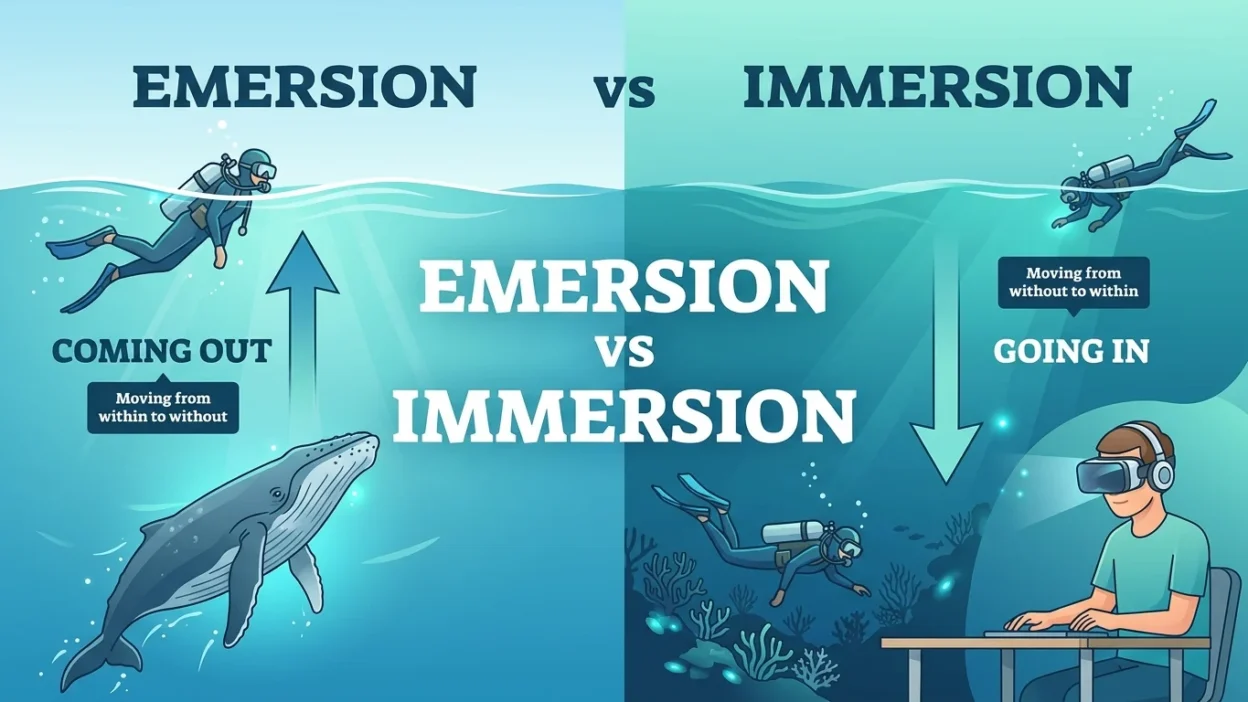
Immersion means being completely involved in or submerged in something, physically or mentally.
Emersion means emerging or coming out from a submerged state, especially from water.
The key difference in emersion vs immersion is simple: immersion is going into something, while emersion is coming out of it.
Emersion vs Immersion: Main Comparison Table
| Feature | Emersion | Immersion |
|---|---|---|
| Meaning | Coming out of a liquid or submerged state | Being submerged or deeply involved |
| Direction | Upward or outward | Downward or inward |
| Common Usage | Biology, marine science, botany | Education, language learning, technology |
| Context | Physical emergence | Physical or mental involvement |
| Example | A whale rising above water | Learning a language through daily exposure |
What Does Emersion Mean?
Emersion refers to the act of emerging from water or another liquid. It describes the transition from a submerged condition to an exposed state.
Examples of Emersion
- The diver’s emersion was delayed because of safety procedures.
- The turtle’s emersion was captured on video.
- The plant survives alternating periods of submersion and emersion.
In scientific fields, emersion often describes aquatic organisms or objects rising above the water’s surface.
What Does Immersion Mean?
Immersion means being completely surrounded, submerged, or deeply involved in something. The term can describe physical situations and mental experiences.
Examples of Immersion
- Language immersion helps students learn quickly.
- Virtual reality creates a feeling of complete immersion.
- The athlete experienced immersion in cold water therapy.
Immersion commonly refers to total participation or deep engagement.
Key Difference Between Emersion and Immersion
The major difference in emersion vs immersion lies in direction and involvement.
| Aspect | Emersion | Immersion |
|---|---|---|
| Movement | Coming out | Going in |
| Exposure | Becomes visible | Becomes surrounded |
| Focus | Emergence | Involvement |
| State | Leaving submersion | Entering submersion |
A simple way to remember this is:
Emersion = Exit
Immersion = Inside
Why Do People Confuse Emersion and Immersion?
People often confuse these terms because:
- They have similar spellings.
- Both are related to water and movement.
- They share the same root origin.
- They are uncommon words in everyday conversations.
However, their meanings are almost opposite.
Emersion vs Immersion in Education
Education frequently uses the term immersion.
| Educational Context | Appropriate Term |
|---|---|
| Learning through full exposure | Immersion |
| Living in another country to learn a language | Immersion |
| Emerging from a practical exercise | Emersion (rare) |
Example
A student participating in a French-speaking environment experiences language immersion.
Emersion vs Immersion in Science
Science uses both terms regularly.
| Scientific Situation | Term Used |
|---|---|
| A fish jumping out of water | Emersion |
| A sample submerged in a solution | Immersion |
| Aquatic plants exposed during low tide | Emersion |
| Objects placed underwater | Immersion |
Example
Marine biologists study the emersion patterns of certain coastal organisms.
Emersion vs Immersion in Business and Professional Settings
In professional environments, immersion is much more common.
| Industry | Emersion Usage | Immersion Usage |
|---|---|---|
| Business Training | Rare | Employee immersion programs |
| Technology | Rare | Virtual reality immersion |
| Marketing | Rare | Brand immersion experiences |
| Tourism | Rare | Cultural immersion tours |
| Healthcare | Limited | Immersion therapy |
Example
Companies often organize immersive workshops that encourage employee engagement and learning.
Real-Life Examples of Emersion and Immersion
Examples of Emersion
- The submarine’s emersion marked the end of its mission.
- The crocodile’s emersion startled the tourists.
- The diver slowly completed his emersion procedure.
Examples of Immersion
- She improved her Spanish through language immersion.
- Gamers enjoy complete immersion in virtual worlds.
- Meditation can create mental immersion and concentration.
Grammar Forms of Emersion and Immersion
| Word Form | Emersion | Immersion |
|---|---|---|
| Noun | Emersion | Immersion |
| Verb Form | Emerge | Immerse |
| Adjective | Emergent | Immersive |
| Adverb | Emergently (rare) | Immersively |
Example Sentences
- The dolphin emerged from the ocean.
- The students immersed themselves in research.
- The immersive experience felt realistic.
Process Comparison: How Emersion and Immersion Occur
| Step | Emersion Process | Immersion Process |
|---|---|---|
| Starting Point | Underwater | Outside the environment |
| Action | Rising outward | Moving inward |
| End Result | Exposure | Complete involvement |
This process view makes the difference easier to understand.
Memory Tricks to Remember Emersion vs Immersion
Use these memory tips:
Emersion = Exit
- Both start with the letter “E.”
Immersion = Inside
- Think of “I” for inside and involvement.
These simple tricks can help you avoid confusion.
Common Mistakes and Correct Usage
Mistake 1
❌ I learned Japanese through emersion.
✅ I learned Japanese through immersion.
Mistake 2
❌ The whale’s immersion above the water was spectacular.
✅ The whale’s emersion above the water was spectacular.
Mistake 3
❌ The company created an emersion training program.
✅ The company created an immersion training program.
Mistake 4
❌ The diver completed his immersion by coming to the surface.
✅ The diver completed his emersion by coming to the surface.
When Should You Use Emersion?
Use emersion when:
- Something rises from water.
- An object becomes exposed after submersion.
- Describing marine or biological processes.
- Discussing emergence from a submerged state.
When Should You Use Immersion?
Use immersion when:
- Someone is deeply involved in an activity.
- Learning occurs through complete exposure.
- Objects are placed in liquid.
- Discussing virtual reality or cultural experiences.
Frequently Asked Questions (FAQs)
Is emersion the opposite of immersion?
Yes. Emersion means coming out, while immersion means going in or becoming deeply involved.
Which term is more common?
Immersion is much more common in everyday English.
Is language learning called emersion or immersion?
It is called language immersion because learners become fully surrounded by the language.
Can emersion be used outside science?
Yes, but it is relatively rare and usually refers to emerging from a submerged condition.
What is an immersive experience?
An immersive experience completely engages a person’s senses and attention.
Are emersion and emergence the same?
Not exactly. Emersion specifically refers to coming out of a submerged state, while emergence has a broader meaning of appearing or becoming visible.
Conclusion
Understanding emersion vs immersion becomes easy once you remember the direction of movement. Emersion means emerging or coming out from a submerged state, whereas immersion means becoming submerged or deeply involved in something. The terms may look alike, but they serve very different purposes. In everyday English, immersion is far more common, especially in education, technology, and business, while emersion is mainly used in scientific and marine contexts. Remember the simple rule: Emersion equals exit, and immersion equals involvement.