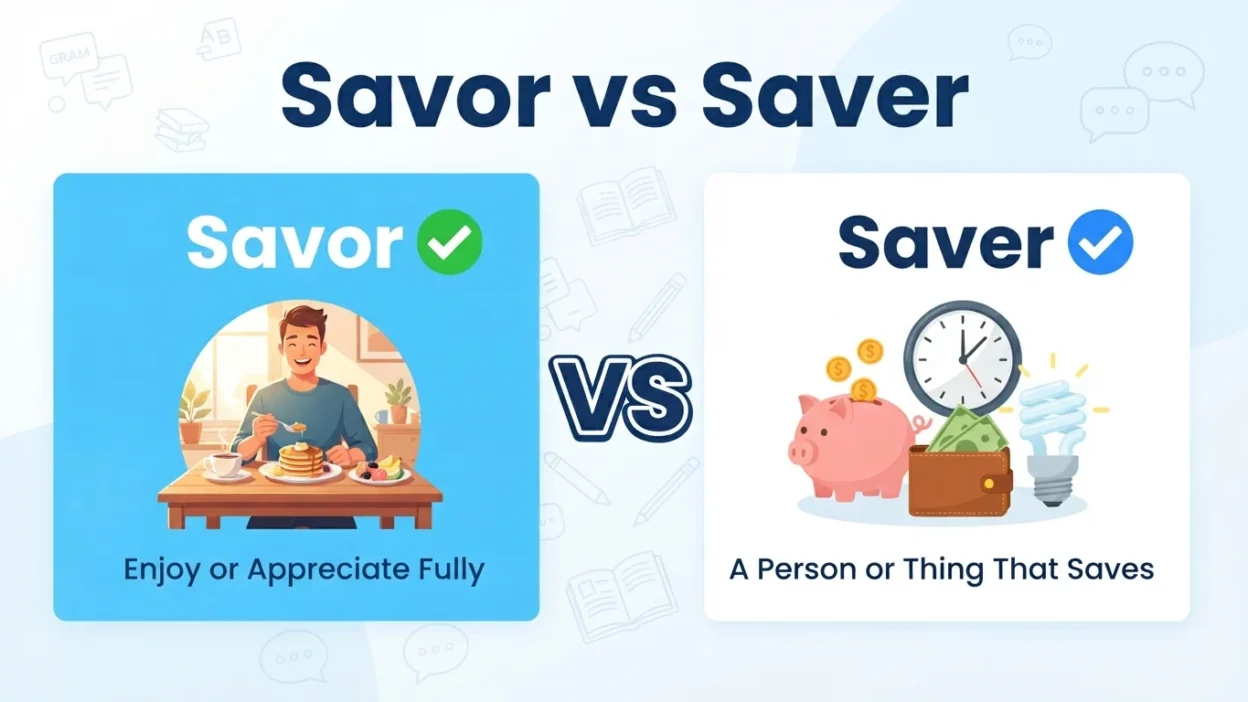
The confusion between savor vs saver is common because the two words look and sound similar, but they have completely different meanings.
While savor is usually related to enjoying or appreciating something, saver refers to a person or thing that saves time, money, energy, or even lives.
Understanding savor vs saver will help you avoid mistakes in writing and speaking.
Learning the difference between savor vs saver is important because each word belongs to a different part of speech and is used in different contexts.
Ifyou’re writing an email, a school assignment, or professional content, choosing the correct word makes your English clearer and more accurate.
This guide explains their meanings, grammar, usage, examples, common mistakes, and practical tips in simple English.
Quick Answer
- Savor means to enjoy or appreciate something slowly and fully.
- Saver means a person or thing that saves something, such as money, time, or lives.
- Although they sound alike, savor is usually a verb, while saver is usually a noun.
Savor vs Saver Comparison Table
| Feature | Savor | Saver |
|---|---|---|
| Meaning | To enjoy fully | A person or thing that saves |
| Part of Speech | Verb (sometimes noun) | Noun |
| Common Context | Food, experiences, moments | Money, time, safety |
| Pronunciation | SAY-ver | SAY-ver |
| Example | Savor every bite. | She is a money saver. |
What Does “Savor” Mean?
Savor means to enjoy, appreciate, or experience something slowly and completely.
It often refers to food, pleasant moments, achievements, or experiences.
Examples
- Savor every bite of the cake.
- We savored the beautiful sunset.
- She savored her success.
- Take time to savor the moment.
As a noun, savor can also mean a particular taste or flavor, although this usage is less common.
Example:
- The soup had a rich savor.
What Does “Saver” Mean?
Saver is a noun that describes someone or something that saves money, time, energy, effort, or lives.
It is commonly used in everyday English.
Examples
- He is a careful saver.
- This app is a time saver.
- Solar panels are energy savers.
- Firefighters are life savers.
The Main Difference Between Savor vs Saver
| Savor | Saver |
|---|---|
| Means to enjoy | Means to save |
| Usually a verb | Always a noun |
| Refers to experiences or taste | Refers to people or useful things |
| Expresses appreciation | Expresses protection or efficiency |
The easiest way to remember the difference is:
- Savor = Enjoy
- Saver = Save
Grammar Forms
Grammar Forms of Savor
| Form | Word |
|---|---|
| Base Verb | Savor |
| Third-Person Singular | Savors |
| Present Participle | Savoring |
| Past Tense | Savored |
| Past Participle | Savored |
Grammar Forms of Saver
| Form | Word |
|---|---|
| Singular Noun | Saver |
| Plural Noun | Savers |
Unlike savor, saver has no verb forms because it is a noun.
When Should You Use “Savor”?
Use savor whenever you are talking about enjoying something slowly or appreciating an experience.
Examples
- Savor your vacation.
- She savored every compliment.
- Let’s savor this achievement.
- He savored the aroma of fresh coffee.
When Should You Use “Saver”?
Use saver when referring to someone or something that saves resources.
Examples
- This coupon is a money saver.
- A dishwasher is a time saver.
- He has always been a careful saver.
- The software is a productivity saver.
Real-Life Examples
Business
| Sentence | Correct Word |
|---|---|
| The automation tool is a huge time saver. | Saver |
| Savor your team’s success after the project. | Savor |
Education
| Sentence | Correct Word |
|---|---|
| Flashcards are great study-time savers. | Saver |
| Students should savor graduation day. | Savor |
Science
| Sentence | Correct Word |
|---|---|
| Renewable technology is an energy saver. | Saver |
| Scientists savored years of successful research. | Savor |
Daily Life
| Sentence | Correct Word |
|---|---|
| Savor every family dinner. | Savor |
| A slow cooker is a time saver. | Saver |
Industry Usage Table
| Industry | Savor | Saver |
|---|---|---|
| Food | Savor every flavor | — |
| Finance | — | Money saver |
| Technology | Savor user experience | Time saver |
| Healthcare | Savor recovery moments | Life saver |
| Marketing | Savor premium experiences | Cost saver |
| Travel | Savor the journey | Fuel saver |
Why Do People Confuse Savor and Saver?
Several factors cause confusion:
- They have similar spelling.
- They are pronounced almost the same.
- Only one letter is different.
- Both are common English words.
- Spell-check tools may not detect the mistake because both words are correctly spelled.
Common Mistakes
| Incorrect | Correct |
|---|---|
| Saver every moment. | Savor every moment. |
| She is good at savoring money. | She is good at saving money. |
| This is a savor of time. | This is a saver of time. |
| The coupon helps you savor money. | The coupon helps you save money. |
Correct vs Incorrect Sentences
Correct
- Savor every opportunity.
- This app is a real time saver.
- We savored the delicious meal.
- She is an excellent money saver.
Incorrect
- Saver every opportunity.
- This app is a real savor.
- We saver the delicious meal.
- She is an excellent savor of money.
Memory Trick
A simple way to remember savor vs saver is:
- Savor contains “avor,” reminding you of flavor and enjoying food.
- Saver contains “save,” reminding you of saving money, time, or effort.
Think:
- Flavor → Savor
- Save → Saver
How to Choose the Correct Word
| Step | Question | Use |
|---|---|---|
| 1 | Are you talking about enjoyment? | Savor |
| 2 | Are you talking about saving resources? | Saver |
| 3 | Is it an action? | Savor |
| 4 | Is it a person or object? | Saver |
| 5 | Does it mean appreciate slowly? | Savor |
People Also Ask
Is savor a verb or noun?
It is mainly a verb, although it can also be a noun meaning taste or flavor.
Is saver a verb?
No. Saver is always a noun.
What is the difference between savor and saver?
Savor means to enjoy something deeply, while saver refers to someone or something that saves time, money, energy, or lives.
Can I say “saver the moment”?
No. The correct phrase is savor the moment.
What is a time saver?
A time saver is something that helps you complete tasks more quickly.
Conclusion
Understanding savor vs saver is simple once you know their meanings. Savor is about enjoying or appreciating experiences, food, or special moments, while saver refers to a person or thing that helps save money, time, energy, or effort.
Although the words sound similar, they have different grammatical roles and should never be used interchangeably. Remember the easy rule: savor means enjoy, saver means save. Following this guideline will help you use both words accurately in everyday conversations and professional writing.