The difference between do not vs don’t is one of the most common grammar questions in English.
Both expressions have the same meaning, but they are used in different situations depending on the level of formality.
Understanding do not vs don’t helps you choose the right tone for emails, conversations, academic writing, and professional communication.
Although do not vs don’t simply involves a contraction, using the correct form can make your writing sound more natural and appropriate.
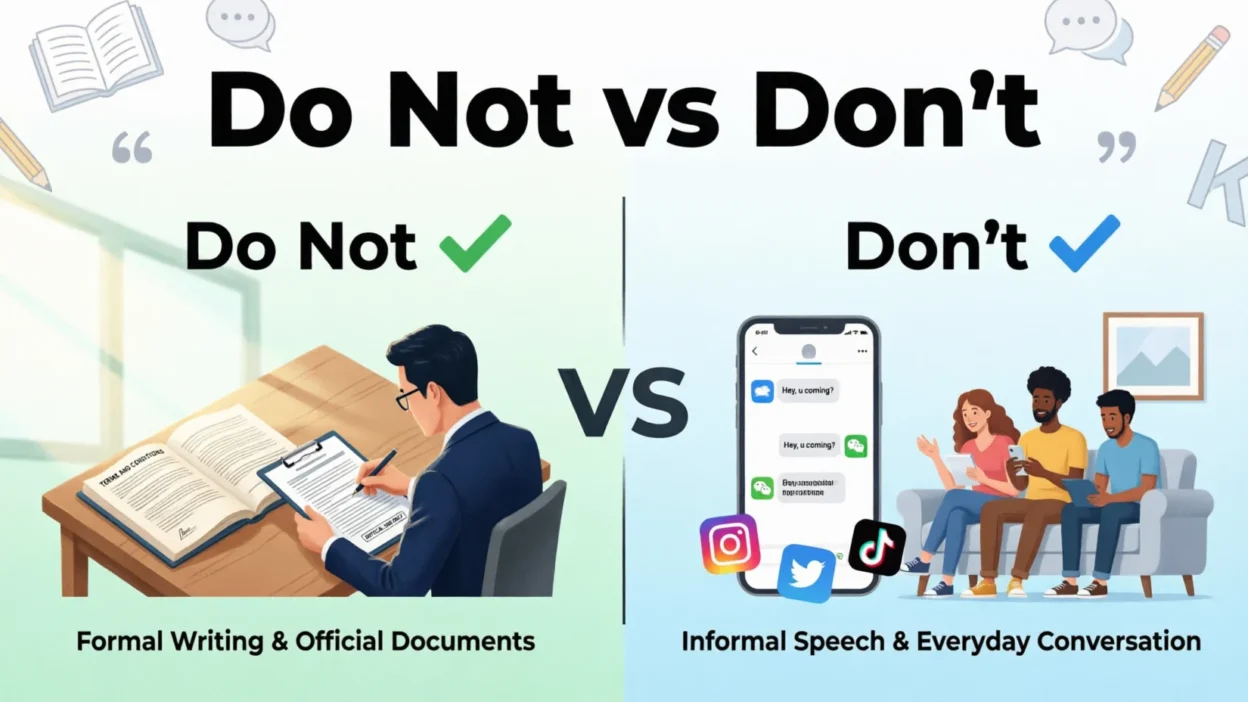
Do not is generally preferred in formal writing or when emphasizing a point, while don’t is common in everyday speech and informal writing.
This guide explains the meaning, grammar rules, differences, examples, and usage tips so you can confidently use both forms.
Quick Answer
- Do not is the full form and is more formal.
- Don’t is the contraction of do not and is more informal.
- Both mean exactly the same thing, but the choice depends on the situation and tone.
Do Not vs Don’t Comparison Table
| Feature | Do Not | Don’t |
|---|---|---|
| Meaning | Negative form of “do” | Contraction of “do not” |
| Formality | Formal | Informal |
| Common in speech | Less common | Very common |
| Common in academic writing | Yes | Usually avoided |
| Meaning difference | None | None |
What Does “Do Not” Mean?
Do not is the complete negative form of the auxiliary verb do.
It is used to tell someone not to do something or to express a negative statement in a formal way.
Examples
- Do not open the door.
- Please do not disturb the meeting.
- Do not forget your passport.
- Employees must do not… (Incorrect; see grammar below.)
In formal writing, do not often sounds clearer and more professional.
What Does “Don’t” Mean?
Don’t is the contracted form of do not.
It has exactly the same meaning but creates a more relaxed and conversational tone.
Examples
- Don’t forget your keys.
- Don’t worry about it.
- I don’t know the answer.
- They don’t like spicy food.
It is commonly used in everyday conversations, text messages, blogs, and informal emails.
The Main Difference Between Do Not vs Don’t
| Situation | Preferred Form |
|---|---|
| Academic writing | Do not |
| Business policies | Do not |
| Formal letters | Do not |
| Friendly emails | Don’t |
| Daily conversations | Don’t |
| Text messages | Don’t |
The only real difference is tone, not meaning.
Grammar Forms Table
| Form | Example |
|---|---|
| Positive | I do understand. |
| Negative (Full) | I do not understand. |
| Negative (Contracted) | I don’t understand. |
| Question | Do you understand? |
| Negative Question | Don’t you understand? |
Both forms are grammatically correct.
When Should You Use “Do Not”?
Use do not in formal writing or when you want to emphasize the negative statement.
Examples
- Do not enter without permission.
- Students do not have access after hours.
- Please do not remove this label.
- Do not ignore safety instructions.
The full form is common in legal, academic, and official documents.
When Should You Use “Don’t”?
Use don’t in informal situations and everyday communication.
Examples
- Don’t be late.
- Don’t forget your homework.
- I don’t feel well today.
- They don’t watch television.
Native speakers use don’t much more often in casual speech.
Real-Life Examples
Business
| Sentence | Preferred Form |
|---|---|
| Do not disclose confidential information. | Do Not |
| Don’t forget tomorrow’s meeting. | Don’t |
Education
| Sentence | Preferred Form |
|---|---|
| Students do not use calculators during this exam. | Do Not |
| Don’t forget to submit your assignment. | Don’t |
Science
| Sentence | Preferred Form |
|---|---|
| Do not mix these chemicals. | Do Not |
| Don’t touch the equipment without permission. | Don’t |
Daily Conversation
| Sentence | Preferred Form |
|---|---|
| Don’t call me so late. | Don’t |
| I don’t understand this question. | Don’t |
Professional and Industry Usage
| Industry | Preferred Form | Example |
|---|---|---|
| Legal | Do Not | Do not copy this document. |
| Healthcare | Do Not | Do not exceed the recommended dose. |
| Education | Do Not | Do not write outside the box. |
| Customer Service | Both | Don’t hesitate to contact us. |
| Marketing | Don’t | Don’t miss this limited-time offer! |
| Corporate Policies | Do Not | Employees do not share passwords. |
Why Do People Confuse Do Not and Don’t?
The confusion exists because:
- They have exactly the same meaning.
- One is simply the contracted form of the other.
- Some teachers discourage contractions in formal writing.
- Informal English uses contractions almost all the time.
- Learners often think one form is grammatically more correct than the other.
In reality, both are grammatically correct.
Common Mistakes
| Incorrect | Correct |
|---|---|
| Don’t enter the password in a legal notice. | Do not enter the password in a legal notice. |
| Do not worry, everything is fine. (Casual conversation) | Don’t worry, everything is fine. |
| I do not know lol. | I don’t know. |
| Employees don’t disclose confidential data. (Formal policy) | Employees do not disclose confidential data. |
Correct vs Incorrect Sentences
Correct
- Do not park here.
- Don’t forget your umbrella.
- We do not accept cash.
- I don’t agree with that idea.
Incorrect
- Do’nt forget your keys.
- Do notn’t worry.
- Dont call me tonight.
- I do’nt know the answer.
Memory Trick
Remember this simple rule:
- Do Not = Formal
- Don’t = Friendly
Think:
Official document → Do Not
Conversation → Don’t
If you’re unsure, ask yourself whether the writing is formal or informal.
How to Choose the Right Form
| Step | Question | Use |
|---|---|---|
| 1 | Is it a formal document? | Do Not |
| 2 | Is it an academic paper? | Do Not |
| 3 | Is it casual speech? | Don’t |
| 4 | Is it a text or social media post? | Don’t |
| 5 | Do you want emphasis? | Do Not |
People Also Ask
Is “don’t” grammatically correct?
Yes. Don’t is the standard contraction of do not and is grammatically correct.
Is “do not” more formal?
Yes. Do not is preferred in formal writing, official documents, and academic work.
Do “do not” and “don’t” mean the same thing?
Yes. They have identical meanings. The difference is only in tone and formality.
Should I avoid contractions in essays?
Many academic style guides recommend using do not instead of don’t in formal essays unless contractions are specifically allowed.
Which form is more common in everyday English?
Don’t is far more common in daily conversations and informal writing.
Conclusion
Understanding do not vs don’t is simple because both forms share the same meaning. The key difference lies in tone and formality rather than grammar. Use do not for formal writing, professional documents, academic papers, and situations where you want to emphasize a negative statement.
Use don’t in conversations, emails to friends, blogs, and everyday communication. By choosing the appropriate form for your audience, your English will sound more natural, polished, and effective.effective.effective.effective.effective.effective.effective.effective.1

Julian Wyatt is a passionate researcher and writer who explores symbols, mythology, cultural traditions, and hidden meanings. Through engaging articles, he helps readers uncover the fascinating stories and significance behind symbols worldwide.