The confusion between bespectacled vs bespeckled is more common than many people realize because the two words look and sound similar. However, they have completely different meanings and are used in different situations.
If you’ve ever wondered which word is correct in a sentence, this guide will make the difference easy to understand.
In this article, you’ll learn the bespectacled vs bespeckled meaning, pronunciation, usage, grammar, examples, and common mistakes. Whether you’re writing an academic paper, business content, or simply improving your English vocabulary, understanding bespectacled vs bespeckled will help you choose the right word confidently.
Quick Answer
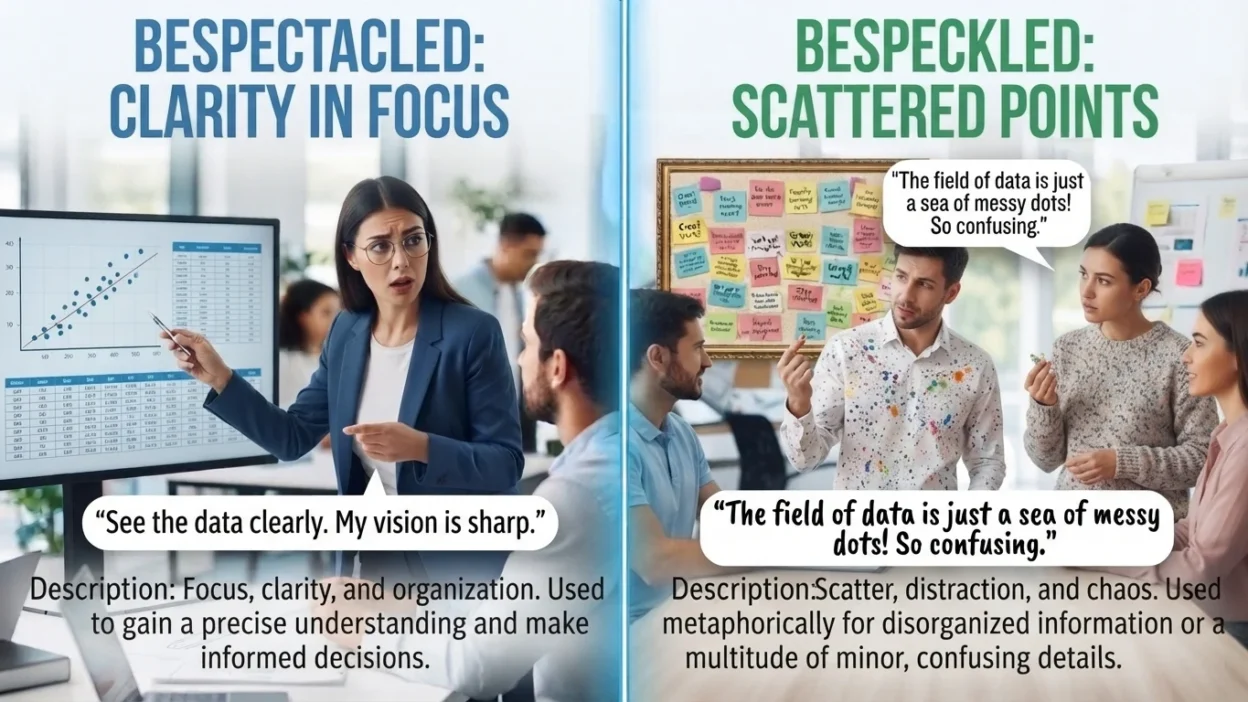
Bespectacled means wearing glasses or spectacles.
Bespeckled means covered with small spots, dots, or specks.
Although they sound alike, they describe completely different things and should never be used interchangeably.
Bespectacled vs Bespeckled: Comparison Table
| Feature | Bespectacled | Bespeckled |
|---|---|---|
| Meaning | Wearing glasses | Covered with small spots or specks |
| Refers To | People | Objects, clothing, animals, surfaces, sometimes people |
| Part of Speech | Adjective | Adjective |
| Common Usage | Describing appearance | Describing texture or pattern |
| Related Word | Spectacles | Specks |
| Modern Usage | Common | Less common but correct |
| Example | A bespectacled teacher | A bespeckled butterfly |
What Does Bespectacled Mean?
Bespectacled is an adjective used to describe someone who wears glasses or spectacles.
The word comes from spectacles, meaning eyeglasses.
Examples
- The bespectacled professor explained the theory clearly.
- A bespectacled accountant welcomed the clients.
- The bespectacled student answered every question confidently.
- The detective interviewed a bespectacled witness.
In modern English, this word is often found in books, newspapers, and descriptive writing.
What Does Bespeckled Mean?
Bespeckled means covered with many tiny spots, dots, or specks.
It describes appearance rather than eyewear.
Examples
- The bird had bespeckled feathers.
- Her dress was bespeckled with glitter.
- The old mirror became bespeckled with dust.
- The cookies were bespeckled with chocolate chips.
Unlike bespectacled, this word can describe both living and non-living things.
Main Differences Between Bespectacled vs Bespeckled
| Aspect | Bespectacled | Bespeckled |
|---|---|---|
| Root Word | Spectacles | Specks |
| Main Meaning | Wearing glasses | Covered with tiny spots |
| Used For | People | Objects, animals, clothing, surfaces |
| Visual Description | Eyewear | Pattern or texture |
| Everyday Frequency | More common | Less common |
The easiest way to remember the difference is this:
- Spectacles = Glasses = Bespectacled
- Specks = Tiny dots = Bespeckled
When Should You Use Bespectacled?
Use bespectacled whenever you’re describing someone who wears glasses.
Examples
Education
- The bespectacled principal greeted new students.
Business
- The bespectacled consultant presented the financial report.
Healthcare
- The bespectacled doctor reviewed the patient’s chart.
Daily Conversation
- I met a friendly bespectacled neighbor today.
When Should You Use Bespeckled?
Choose bespeckled when describing something covered with tiny marks or dots.
Examples
Nature
- The frog had bespeckled skin.
Fashion
- She wore a bespeckled scarf.
Food
- The bread was bespeckled with herbs.
Home
- The old window became bespeckled with rain.
Real-Life Examples in Different Contexts
| Context | Bespectacled Example | Bespeckled Example |
|---|---|---|
| Business | The bespectacled manager held the meeting. | The presentation board was bespeckled with colored dots. |
| Education | The bespectacled professor taught chemistry. | The science chart was bespeckled with symbols. |
| Science | A bespectacled researcher examined samples. | The specimen appeared bespeckled under the microscope. |
| Nature | The bespectacled hiker used binoculars. | The bird had bespeckled wings. |
| Fashion | The bespectacled model wore stylish frames. | The fabric was bespeckled with silver patterns. |
Why Do People Confuse Bespectacled vs Bespeckled?
There are several reasons.
- Both begin with “bes-“
- Their spelling looks nearly identical.
- Their pronunciation is similar.
- Both are uncommon adjectives.
- Many people rarely encounter bespeckled in everyday writing.
Despite their similarities, the meanings are entirely unrelated.
Grammar Forms
| Word | Part of Speech | Example |
|---|---|---|
| Bespectacled | Adjective | A bespectacled engineer arrived. |
| Bespeckled | Adjective | A bespeckled leaf covered the ground. |
| Spectacles | Noun | She bought new spectacles. |
| Speck | Noun | There was a speck of dust. |
| Speckled | Adjective | The eggs were naturally speckled. |
Neither bespectacled nor bespeckled functions as a verb.
Professional and Industry Usage
| Industry | Bespectacled | Bespeckled |
|---|---|---|
| Journalism | Describing people | Describing scenes or objects |
| Literature | Character descriptions | Nature and imagery |
| Education | Teachers and students | Classroom materials |
| Biology | Rare | Animal patterns |
| Fashion | Eyewear descriptions | Fabric designs |
| Marketing | Character profiles | Product appearance |
Memory Tricks to Remember the Difference
| Word | Memory Trick |
|---|---|
| Bespectacled | Think of spectacles, which means glasses. |
| Bespeckled | Think of specks, meaning tiny dots. |
Another simple trick:
- Spectacles → Glasses
- Specks → Spots
Common Mistakes and Corrections
| Incorrect Sentence | Correct Sentence |
|---|---|
| The bespeckled professor taught physics. | The bespectacled professor taught physics. |
| The bird was bespectacled with white dots. | The bird was bespeckled with white dots. |
| Her dress looked bespectacled. | Her dress looked bespeckled. |
| The bespeckled lawyer wore black glasses. | The bespectacled lawyer wore black glasses. |
Examples of Correct Usage
Bespectacled
- A bespectacled librarian helped me.
- The bespectacled scientist won an award.
- Every bespectacled student received new lenses.
- The bespectacled editor checked the article carefully.
Bespeckled
- The butterfly had bespeckled wings.
- The walls became bespeckled with paint.
- The cookies were bespeckled with chocolate pieces.
- The stone appeared naturally bespeckled.
Tips for Using the Right Word
| Situation | Correct Word |
|---|---|
| Someone wearing glasses | Bespectacled |
| Fabric with tiny dots | Bespeckled |
| Dust-covered surface | Bespeckled |
| Teacher wearing spectacles | Bespectacled |
| Bird with spotted feathers | Bespeckled |
People Also Ask
Is bespectacled a real English word?
Yes. Bespectacled is a standard English adjective meaning “wearing glasses.”
Is bespeckled the same as speckled?
Not exactly. Both relate to spots, but bespeckled emphasizes being covered with many specks, while speckled is more commonly used in everyday English.
Can bespeckled describe people?
Yes, but only if they are covered with spots, freckles, dust, paint, or similar marks—not because they wear glasses.
Which word is more common?
Bespectacled is generally more common in modern writing than bespeckled.
Can I use bespectacled for objects?
No. It specifically refers to people or animals wearing glasses.
Frequently Asked Questions
What is the main difference between bespectacled vs bespeckled?
Bespectacled means wearing glasses, while bespeckled means covered with tiny spots.
Is bespectacled formal?
Yes. It is commonly used in formal and descriptive writing.
Is bespeckled an old-fashioned word?
It is less common today but remains correct and appears in literature and descriptive writing.
Which word should I use for clothing with dots?
Use bespeckled because it describes a spotted appearance.
Are bespectacled and bespeckled synonyms?
No. Their meanings are completely different.
Conclusion
Understanding bespectacled vs bespeckled is simple once you know their origins. Bespectacled always refers to someone wearing glasses because it comes from spectacles. Bespeckled, on the other hand, refers to something covered with tiny spots or specks.
Although these words share similar spelling and pronunciation, they describe entirely different characteristics. Remember this simple rule: glasses mean bespectacled, while spots mean bespeckled. Using the correct word will make your writing clearer, more accurate, and more professional.