Many English learners confuse indolence vs insolence because the words look and sound somewhat similar.
However, they have completely different meanings. Understanding indolence vs insolence is important because using the wrong word can change the meaning of your sentence entirely.
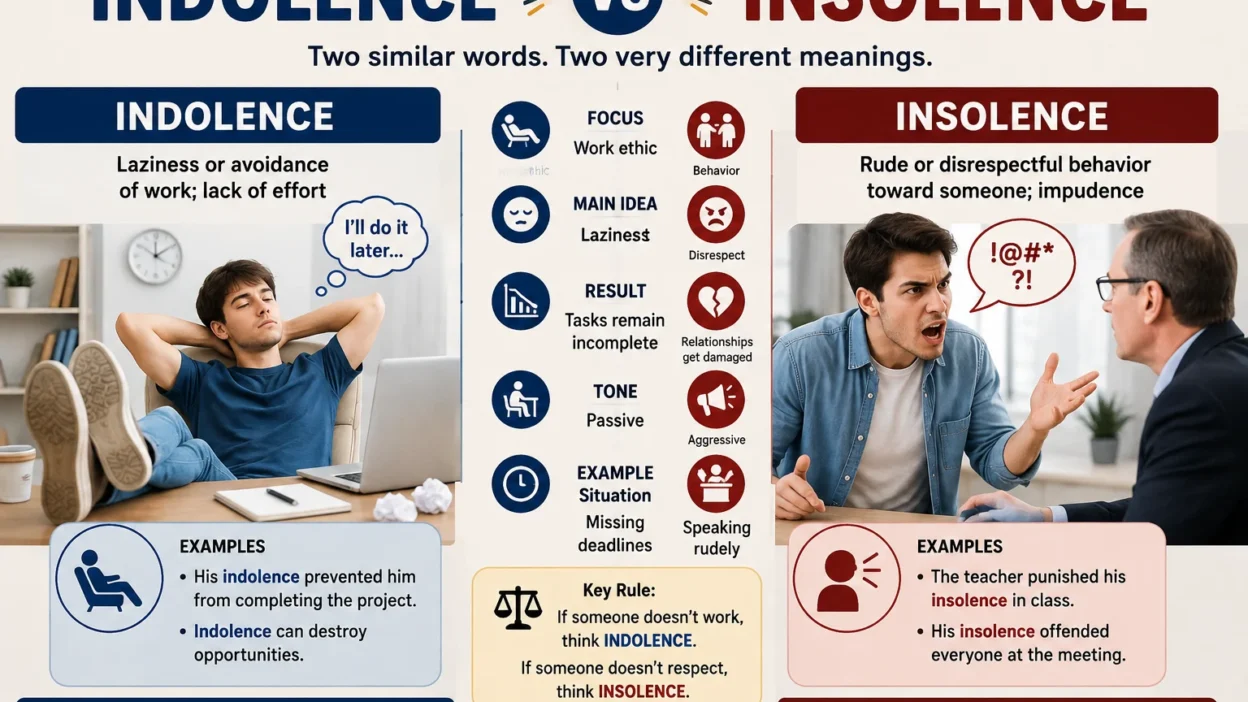
In simple terms, indolence refers to laziness or avoiding work, while insolence refers to rude or disrespectful behavior.
This guide explains the meaning, difference, usage, grammar, examples, and common mistakes so you can confidently use both words in everyday and professional English.
Quick Answer
The difference between indolence vs insolence is simple:
- Indolence means laziness or unwillingness to work.
- Insolence means rude, disrespectful, or insulting behavior toward someone.
- Although they look alike, they describe completely different attitudes.
Indolence vs Insolence Comparison Table
| Feature | Indolence | Insolence |
|---|---|---|
| Meaning | Laziness or avoidance of work | Rude or disrespectful behavior |
| Part of Speech | Noun | Noun |
| Describes | Lack of effort | Lack of respect |
| Related Adjective | Indolent | Insolent |
| Opposite | Diligence | Respectfulness |
| Common Contexts | Work, study, productivity | Behavior, communication, discipline |
What Does Indolence Mean?
Indolence means avoiding physical or mental effort. It describes someone who is lazy, inactive, or unwilling to work.
Examples
- His indolence prevented him from completing the project.
- Years of indolence affected his career growth.
- The manager warned employees against workplace indolence.
Synonyms
- Laziness
- Idleness
- Sloth
- Inactivity
- Lethargy
What Does Insolence Mean?
Insolence refers to rude, arrogant, or disrespectful behavior, especially toward authority or older people.
Examples
- The teacher punished the student’s insolence.
- His insolence offended everyone at the meeting.
- Speaking with insolence can damage professional relationships.
Synonyms
- Rudeness
- Disrespect
- Impudence
- Arrogance
- Sass
Indolence vs Insolence: Key Differences
| Aspect | Indolence | Insolence |
|---|---|---|
| Focus | Work ethic | Behavior |
| Main Idea | Laziness | Disrespect |
| Problem | Doesn’t want to work | Doesn’t show respect |
| Emotional Tone | Passive | Aggressive |
| Typical Situation | Missing deadlines | Speaking rudely |
Easy Rule
If someone doesn’t work, think indolence.
If someone doesn’t respect, think insolence.
Grammar Forms of Indolence and Insolence
| Word Form | Indolence | Insolence |
|---|---|---|
| Noun | Indolence | Insolence |
| Adjective | Indolent | Insolent |
| Adverb | Indolently | Insolently |
| Person | Indolent person | Insolent person |
Example Sentences
| Form | Example |
|---|---|
| Indolent | He became indolent after retirement. |
| Indolently | She walked indolently across the room. |
| Insolent | The employee gave an insolent reply. |
| Insolently | He spoke insolently to the supervisor. |
When Should You Use Indolence?
Use indolence whenever discussing laziness, inactivity, or lack of motivation.
Examples include:
- Employee performance
- Student behavior
- Personal habits
- Productivity
- Health discussions
Example Sentences
- His indolence cost him the promotion.
- The coach discouraged indolence among athletes.
- Financial success rarely comes through indolence.
When Should You Use Insolence?
Use insolence whenever discussing disrespectful speech or behavior.
Common situations include:
- Schools
- Offices
- Military
- Customer service
- Family discussions
Example Sentences
- The child’s insolence upset his parents.
- Workplace insolence can lead to disciplinary action.
- The judge did not tolerate insolence in court.
Why Do People Confuse Indolence vs Insolence?
Several reasons explain the confusion.
| Reason | Explanation |
|---|---|
| Similar spelling | Both begin with “in-“ |
| Similar pronunciation | The endings sound alike |
| Same word type | Both are nouns |
| Rare vocabulary | Neither word is commonly used daily |
The meanings, however, are completely unrelated.
Real-Life Examples
Business
Indolence
- Employee productivity declined because of indolence.
Insolence
- The manager issued a warning for employee insolence.
Education
Indolence
- Indolence caused poor exam preparation.
Insolence
- The student received detention for insolence toward the teacher.
Healthcare
Indolence
- Doctors encouraged exercise to overcome physical indolence.
Insolence
- Patients are expected to avoid insolence toward medical staff.
Sports
Indolence
- Indolence during training reduced athletic performance.
Insolence
- Insolence toward referees resulted in penalties.
Industry Usage Table
| Industry | Indolence Example | Insolence Example |
|---|---|---|
| Business | Low productivity | Rude employee |
| Education | Lazy student | Disrespectful student |
| Healthcare | Lack of physical activity | Rude patient |
| Customer Service | Poor work ethic | Impolite representative |
| Sports | Poor training effort | Arguing with officials |
Common Mistakes
Many learners accidentally replace one word with the other.
| Incorrect Sentence | Correct Sentence |
|---|---|
| His insolence made him fail because he never studied. | His indolence made him fail because he never studied. |
| The teacher punished his indolence for talking back. | The teacher punished his insolence for talking back. |
| Workplace insolence reduced productivity. | Workplace indolence reduced productivity. |
| The rude customer showed indolence. | The rude customer showed insolence. |
Memory Tricks
Remember these simple tricks.
| Word | Memory Trick |
|---|---|
| Indolence | Think Idle = Lazy |
| Insolence | Think Insult = Rude |
Another easy reminder:
- Indolence = Idle person
- Insolence = Insulting person
How to Choose the Correct Word
Follow these simple steps.
| Question | Choose |
|---|---|
| Is the person lazy? | Indolence |
| Is the person disrespectful? | Insolence |
| Is it about work habits? | Indolence |
| Is it about manners? | Insolence |
This quick process helps you avoid mistakes in writing and speaking.
Similar Words Worth Knowing
| Word | Meaning |
|---|---|
| Indolent | Lazy |
| Idle | Not working |
| Diligence | Hard work |
| Insolent | Rude |
| Impudent | Boldly disrespectful |
| Arrogant | Overly proud |
Practice Examples
Choose the correct word.
- The employee’s ________ delayed the project.
Answer: Indolence - The student’s ________ shocked the principal.
Answer: Insolence - Years of ________ prevented career growth.
Answer: Indolence - His ________ toward customers led to dismissal.
Answer: Insolence
Frequently Asked Questions
Is indolence the same as insolence?
No. Indolence means laziness, while insolence means rude or disrespectful behavior.
Can someone be both indolent and insolent?
Yes. A person can be lazy and also disrespectful at the same time.
Which word relates to work performance?
Indolence relates to work ethic and productivity.
Which word describes bad manners?
Insolence describes rude or disrespectful behavior.
Are indolence and insolence interchangeable?
No. They have different meanings and should never replace each other.
Conclusion
Understanding indolence vs insolence is straightforward once you remember what each word describes.
Indolence refers to laziness, inactivity, or avoiding effort, while refers to disrespectful, rude, or insulting behavior.
Although the words look similar, they apply to completely different situations.
When discussing work habits, motivation, or productivity, choose indolence. When talking about manners, attitude, or disrespect toward others, choose insolence.
Remember the simple rule: idle equals indolence, insult equals insolence, and you’ll use both words correctly every time.