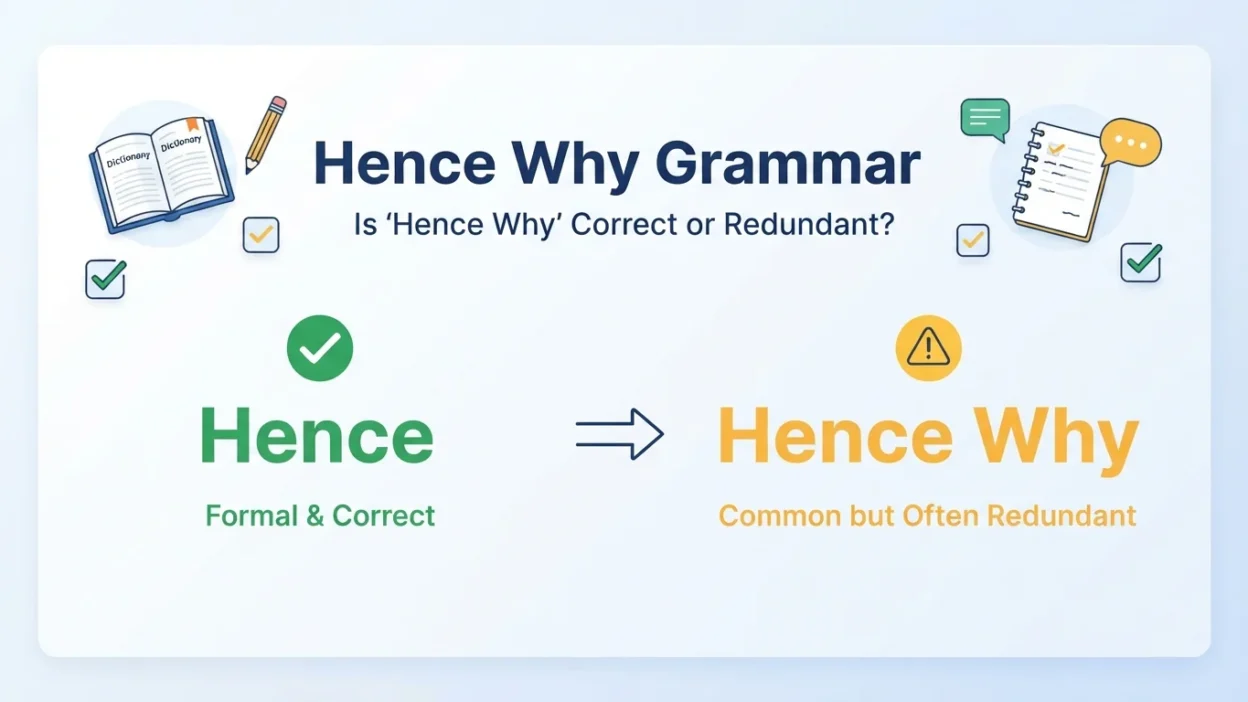
Hence why grammar is a topic that often confuses English learners, writers, and even native speakers.
Many people wonder whether the phrase “hence why” is grammatically correct or whether it is considered redundant.
Since both hence and why express a reason, using them together may sound repetitive to some grammar experts.
Understanding hence why grammar helps you write more clearly and professionally.
In this guide, you’ll learn the meaning of hence why, when it’s acceptable to use it, when to avoid it, common mistakes, grammar rules, real world examples, and practical tips to remember the correct usage.
Quick Answer
“Hence why” is commonly used in everyday English but is often considered redundant in formal writing because hence already means “for this reason.” In formal contexts, it’s usually better to use either hence or why, not both together.
What Does “Hence Why” Mean?
The phrase “hence why” means:
For this reason why or that is the reason why.
Although many people use it naturally in speech and informal writing, grammar experts often point out that the expression repeats the idea of reason.
Examples
- This is hence why we changed the policy.
- That’s hence why I arrived early.
Many editors would revise these sentences to make them shorter and clearer.
Is “Hence Why” Grammatically Correct?
The answer depends on the writing style.
In everyday conversation, hence why is widely accepted because it sounds natural.
In formal grammar, however, many style guides recommend avoiding it because hence already means therefore or for this reason.
Better Alternatives
- Hence
- Therefore
- That is why
- For this reason
- Consequently
Main Comparison Table
| Phrase | Meaning | Formal Writing | Informal Writing | Recommended |
|---|---|---|---|---|
| Hence | For this reason | ✅ Yes | ✅ Yes | Highly recommended |
| Hence why | For this reason why | ⚠ Usually avoided | ✅ Common | Acceptable informally |
| That is why | Explains a reason | ✅ Yes | ✅ Yes | Recommended |
| Therefore | As a result | ✅ Yes | ✅ Yes | Recommended |
| Consequently | Result of something | ✅ Yes | ✅ Yes | Recommended |
Why Do Grammar Experts Consider “Hence Why” Redundant?
The confusion comes from the meanings of the individual words.
- Hence = for this reason
- Why = for what reason
Putting them together creates a repeated meaning.
Example
❌ Hence why we canceled the event.
✅ Hence, we canceled the event.
✅ That is why we canceled the event.
The second and third examples are clearer and more concise.
Difference Between “Hence” and “Hence Why”
| Feature | Hence | Hence Why |
|---|---|---|
| Meaning | For this reason | For this reason why |
| Grammar | Standard | Often considered redundant |
| Formal writing | Preferred | Usually avoided |
| Spoken English | Common | Very common |
| Academic writing | Recommended | Not recommended |
When Should You Use “Hence Why”?
Although some editors dislike the phrase, it still appears in:
- Everyday conversations
- Interviews
- Blog posts
- Social media
- Casual emails
- Informal articles
Example
“I forgot my passport, hence why I missed the flight.”
Most readers understand the meaning immediately.
When Should You Avoid “Hence Why”?
Avoid it in:
- Academic papers
- Business reports
- Research articles
- Legal writing
- Professional documentation
- Official emails
Better Versions
Instead of:
Hence why the experiment failed.
Write:
Hence, the experiment failed.
Or
That is why the experiment failed.
Grammar Forms Table
| Expression | Grammar Status | Example |
|---|---|---|
| Hence | Correct | Hence, we left early. |
| Hence why | Informally accepted | Hence why we left early. |
| Therefore | Correct | Therefore, we left early. |
| That is why | Correct | That is why we left early. |
| Consequently | Correct | Consequently, we left early. |
Real-Life Examples
Business
Informal:
Sales declined, hence why we reduced prices.
Formal:
Sales declined; hence, we reduced prices.
Education
Informal:
She studied every day, hence why she passed.
Formal:
She studied every day; that is why she passed.
Science
Informal:
The temperature increased, hence why the reaction sped up.
Formal:
The temperature increased; therefore, the reaction sped up.
Daily Conversation
I woke up late, hence why I missed breakfast.
This sentence is perfectly natural in casual speech.
Professional and Industry Usage
| Industry | Preferred Expression |
|---|---|
| Academic Writing | Hence |
| Journalism | Hence or therefore |
| Business Reports | Therefore |
| Legal Writing | Hence |
| Scientific Research | Consequently |
| Blogging | Hence why (acceptable) |
| Social Media | Hence why (common) |
Common Mistakes and Corrections
| Incorrect Sentence | Correct Sentence |
|---|---|
| Hence why I left. | Hence, I left. |
| Hence why the meeting ended. | That is why the meeting ended. |
| Hence why sales increased. | Therefore, sales increased. |
| Hence why we changed plans. | Hence, we changed plans. |
Why Do People Confuse “Hence Why” Grammar?
There are several reasons.
- It sounds natural in conversation.
- Many speakers hear it frequently.
- Social media has made the phrase more common.
- Writers often combine expressions without noticing redundancy.
- Native speakers regularly use redundant phrases in everyday speech.
Because of this, many people assume it is the standard grammatical form.
Memory Trick to Remember the Rule
A simple trick is:
Hence already means “for this reason.”
If you can replace hence why with just hence without changing the meaning, remove why.
Easy Formula
- Formal writing → Use Hence
- Casual conversation → Hence why is acceptable
How to Choose the Right Expression
| Situation | Best Choice |
|---|---|
| Academic essay | Hence |
| Research paper | Therefore |
| Business report | Hence |
| Casual conversation | Hence why |
| Blog article | Hence or hence why |
| Formal email | Hence |
Step-by-Step Editing Process
| Step | Action |
|---|---|
| 1 | Find “hence why” in your writing. |
| 2 | Check whether the writing is formal. |
| 3 | If formal, replace it with “hence.” |
| 4 | Read the sentence again for clarity. |
| 5 | Keep “hence why” only if an informal tone is intended. |
Examples of Correct Usage
Using “Hence”
- The roads were flooded; hence, schools remained closed.
- The software failed; hence, the project was delayed.
- She worked hard; hence, her promotion.
Using “That Is Why”
- He forgot his wallet. That is why he returned home.
- The machine stopped working. That is why production slowed.
Using “Therefore”
- Demand increased; therefore, prices rose.
- The experiment succeeded; therefore, the theory was accepted.
People Also Ask
Is “hence why” wrong?
Not exactly. It is common in spoken English but often considered redundant in formal writing.
Can I use “hence why” in an essay?
It is better to avoid it. Use hence, therefore, or that is why instead.
Why is “hence why” considered redundant?
Because hence already means for this reason, and why repeats the same idea.
Is “hence why” acceptable in conversation?
Yes. It is widely used in everyday speech and casual writing.
Which is better: “hence” or “hence why”?
For formal English, hence is the better choice. For informal conversation, hence why is generally acceptable.
Frequently Asked Questions
Is “hence why” grammatically incorrect?
Not completely. It is understood by most English speakers but is often avoided in formal writing because it is redundant.
What can I use instead of “hence why”?
You can use hence, therefore, consequently, or that is why.
Do native English speakers use “hence why”?
Yes. It appears frequently in conversations, interviews, blogs, and social media.
Is “hence why” acceptable in business writing?
Most editors recommend replacing it with hence or therefore.
Which style guides discourage “hence why”?
Many grammar experts and editors discourage it because it repeats the same meaning, although it is not universally banned.
Conclusion
Understanding hence why grammar makes your writing clearer and more professional. While “hence why” is common in spoken English and informal writing, many grammar experts consider it redundant because hence already means “for this reason.”
In formal writing, choose hence, therefore, consequently, or that is why instead. Knowing when each expression fits the context will help you communicate naturally while maintaining grammatical accuracy.

Julian Wyatt is a passionate researcher and writer who explores symbols, mythology, cultural traditions, and hidden meanings. Through engaging articles, he helps readers uncover the fascinating stories and significance behind symbols worldwide.