Introduction
Many English learners search for emasculate vs demasculate because the two words appear similar and seem to have related meanings.
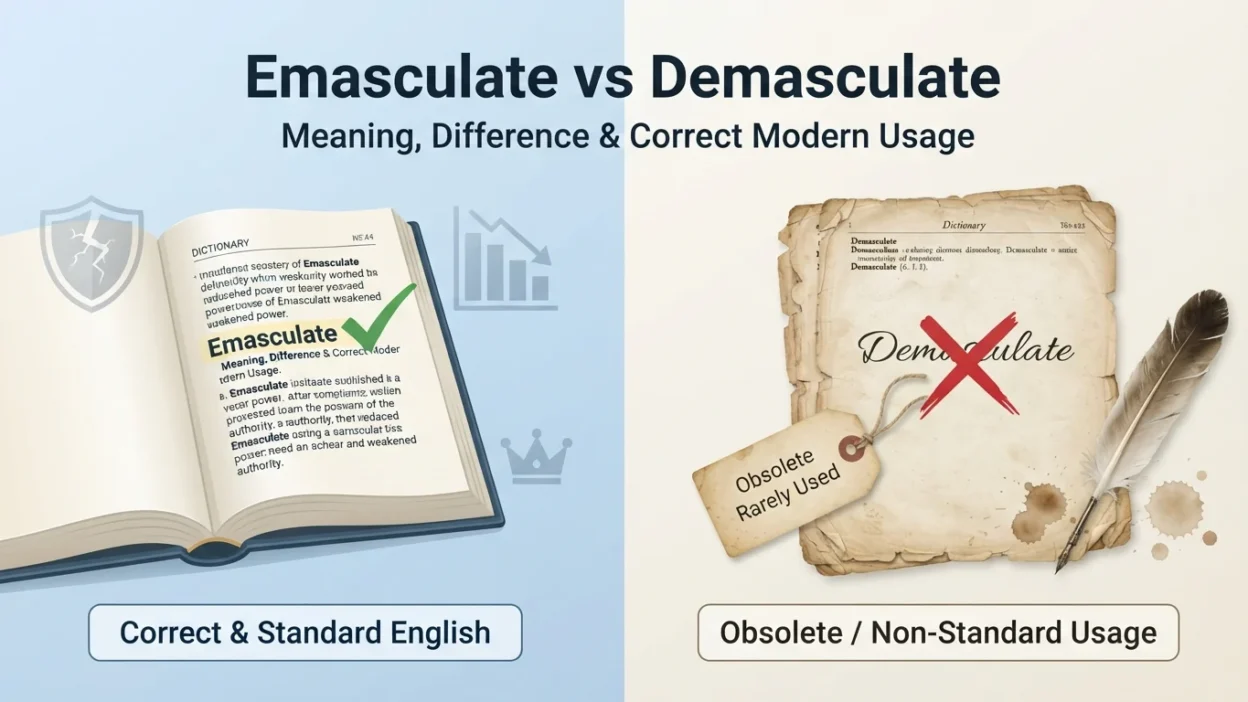
However, this comparison is a bit unusual because emasculate is a standard English word, while demasculate is considered obsolete, extremely rare, or nonstandard in modern English.
Understanding emasculate vs demasculate helps you avoid using a word that most native speakers and dictionaries no longer recognize as common usage.
In this guide, you’ll learn the meaning, difference, grammar, examples, and correct usage of emasculate vs demasculate.
You’ll also discover why one word is widely accepted while the other is rarely used, making it easier to choose the correct term in writing and conversation.
Quick Answer
Emasculate is the correct and commonly accepted English word meaning to weaken, deprive of strength, or reduce masculinity.
Demasculate is an obsolete or very rare variant that is generally not used in modern English. In almost every situation, emasculate is the correct choice.
Emasculate vs Demasculate at a Glance
| Feature | Emasculate | Demasculate |
|---|---|---|
| Status | Standard English | Obsolete/Rare |
| Part of Speech | Verb | Verb (rare) |
| Modern Usage | Yes | Almost never |
| Found in Modern Dictionaries | Yes | Rarely |
| Recommended for Writing | Yes | No |
What Does Emasculate Mean?
Emasculate is a verb that means to weaken someone or something, reduce strength or effectiveness, or symbolically take away traditional masculine qualities.
The word may also appear in historical or medical contexts with a literal meaning, but today it is most often used figuratively.
Examples
- The new policy may emasculate the committee’s authority.
- Critics argued that the changes emasculated the original proposal.
- He felt the constant criticism would emasculate his confidence.
- Excessive editing can emasculate a powerful speech.
What Does Demasculate Mean?
Demasculate is an extremely uncommon word that historically appeared as a variant of emasculate.
Today, it is considered obsolete or nonstandard in modern English. Most dictionaries either omit it or label it as archaic.
Examples
Although rarely seen today, historical texts may include sentences like:
- The old manuscript used the word demasculate.
- Modern editors replaced demasculate with emasculate.
In current English, you should use emasculate instead.
Main Difference Between Emasculate and Demasculate
The primary difference is that emasculate is the accepted modern word, while demasculate has largely disappeared from contemporary English.
| Aspect | Emasculate | Demasculate |
|---|---|---|
| Acceptance | Widely accepted | Rarely accepted |
| Frequency | Common | Extremely rare |
| Dictionaries | Included | Often marked obsolete |
| Professional Writing | Recommended | Avoided |
Grammar Forms
| Word | Part of Speech | Example |
|---|---|---|
| Emasculate | Verb | The decision may emasculate the proposal. |
| Emasculated | Adjective/Past Participle | An emasculated version was published. |
| Emasculating | Present Participle | The edits are emasculating the message. |
| Emasculation | Noun | The emasculation of authority was criticized. |
| Demasculate | Verb (obsolete) | Rare historical usage only. |
When Should You Use Emasculate?
Use emasculate whenever you want to describe weakening power, authority, confidence, or effectiveness.
Correct Examples
- The revised law emasculated the agency’s powers.
- Poor leadership can emasculate a strong team.
- Critics claimed the rewrite emasculated the novel.
- Constant interruptions emasculated the presentation.
Should You Ever Use Demasculate?
In nearly every case, no.
Modern English writers, editors, teachers, journalists, and dictionaries overwhelmingly recommend emasculate instead.
Unless you’re quoting an old document or discussing historical language, avoid demasculate.
Real-Life Examples
Business
| Word | Example |
|---|---|
| Emasculate | Budget cuts emasculated the department’s ability to innovate. |
| Demasculate | Rarely used in modern business writing. |
Education
| Word | Example |
|---|---|
| Emasculate | Removing key lessons may emasculate the curriculum. |
| Demasculate | Not recommended in educational writing. |
Literature
| Word | Example |
|---|---|
| Emasculate | Editors avoided changes that would emasculate the author’s style. |
| Demasculate | May appear in historical literature only. |
Politics
| Word | Example |
|---|---|
| Emasculate | The amendment emasculated the bill’s original purpose. |
| Demasculate | Generally avoided. |
Professional and Industry Usage
| Industry | Emasculate | Demasculate |
|---|---|---|
| Journalism | Common | Avoided |
| Law | Occasionally used | Never used |
| Literature | Common | Historical only |
| Academia | Accepted | Discussed only in language history |
| Publishing | Standard | Edited out in modern texts |
Why Do People Confuse Emasculate and Demasculate?
Several reasons contribute to the confusion.
- Both words share nearly identical spelling.
- The prefix de- often means “remove,” making demasculate sound logical.
- Some older texts contain the rare form.
- Online searches occasionally display outdated references.
- Many learners assume both are equally correct.
Memory Trick
Use this simple trick to remember the correct word.
| Word | Memory Trick |
|---|---|
| Emasculate | Think “English uses emasculate.” |
| Demasculate | Think “Don’t use it in modern English.” |
Remember: if you’re writing today, choose emasculate.
Common Mistakes
Incorrect vs Correct
| Incorrect | Correct |
|---|---|
| The edits demasculated the article. | The edits emasculated the article. |
| His speech was demasculated. | His speech was emasculated. |
| The law demasculates the agency. | The law emasculates the agency. |
| Modern dictionaries recommend demasculate. | Modern dictionaries recommend emasculate. |
How to Choose the Correct Word
| Step | Question | Correct Choice |
|---|---|---|
| 1 | Are you writing modern English? | Emasculate |
| 2 | Are you quoting historical text? | Either (keep original quotation) |
| 3 | Is this academic or professional writing? | Emasculate |
| 4 | Unsure which word to use? | Emasculate |
People Also Ask
Is demasculate a real word?
Yes, but it is an obsolete or extremely rare variant that is generally not used in modern English.
Which word should I use today?
You should almost always use emasculate.
Is emasculate offensive?
It depends on context. The word can be sensitive when referring to people, so writers often use it carefully and only when appropriate.
Does emasculate only refer to men?
No. It is frequently used figuratively to describe weakening policies, organizations, ideas, arguments, or authority.
Frequently Asked Questions
Is demasculate in the dictionary?
Some historical dictionaries include it, but many modern dictionaries either omit it or mark it as obsolete.
Can emasculate describe organizations?
Yes. It often refers to weakening authority, power, or effectiveness.
Is emasculate a formal word?
Yes. It is commonly used in formal writing, journalism, literature, and academic contexts.
Why isn’t demasculate common?
Because emasculate became the standard form in English, while demasculate gradually fell out of use.
Can I use demasculate in an essay?
Unless you’re discussing historical language or quoting an old text, it’s better to use emasculate.
Conclusion
Understanding emasculate vs demasculate is straightforward once you know that only one word is commonly accepted in modern English. Emasculate is the correct choice for describing the weakening of strength, authority, confidence, or effectiveness.
Demasculate, although historically recorded, is obsolete and rarely appears outside historical discussions. For professional writing, academic work, business communication, and everyday English, always choose emasculate. Doing so ensures your writing is accurate, natural, and easily understood by modern readers.

Julian Wyatt is a passionate researcher and writer who explores symbols, mythology, cultural traditions, and hidden meanings. Through engaging articles, he helps readers uncover the fascinating stories and significance behind symbols worldwide.