
Have you ever wondered whether you should write introduction to or introduction of?
This is a common grammar question because both phrases are correct, but they are used in different situations.
Understanding introduction to vs introduction of can help you write more naturally and avoid common English mistakes.
The confusion about introduction to vs introduction of usually comes from the fact that both expressions include the noun introduction.
However, the prepositions to and of change the meaning of the phrase. This guide explains their meanings, differences, examples, grammar rules, and the best situations to use each one correctly.
Quick Answer
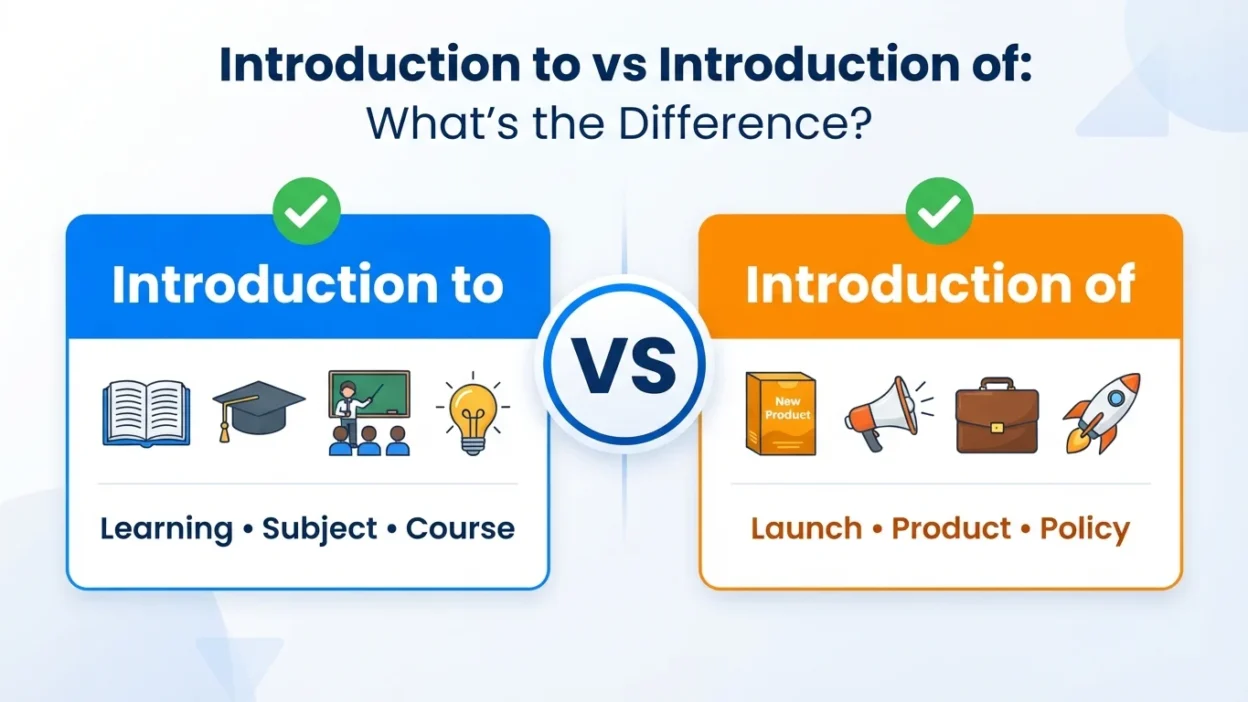
Introduction to is used when referring to a subject, topic, or beginning of learning something.
Introduction of is used when referring to bringing someone or something into a place, system, or situation.
Introduction to vs Introduction of: Main Difference
| Phrase | Meaning | Common Use | Example |
|---|---|---|---|
| Introduction to | Beginning of learning or explaining a subject | Education, books, presentations | Introduction to Biology |
| Introduction of | Bringing or presenting someone or something | Business, government, products | Introduction of a new policy |
The easiest way to remember the difference is:
- To = Learning about something
- Of = Bringing something into existence or presenting it
What Does “Introduction to” Mean?
Introduction to refers to the beginning of learning, studying, or explaining a subject.
It often appears in:
- Textbooks
- Courses
- Training programs
- Tutorials
- Presentations
Examples
- Introduction to Computer Science
- Introduction to Marketing
- This chapter serves as an introduction to economics.
- Our teacher gave an introduction to grammar.
In all these examples, someone is beginning to learn about a topic.
What Does “Introduction of” Mean?
Introduction of refers to presenting, bringing in, or officially starting something new.
It commonly appears when discussing:
- New products
- Policies
- Employees
- Technology
- Laws
Examples
- The introduction of electric vehicles changed transportation.
- The company announced the introduction of a new software system.
- The introduction of stricter rules improved safety.
- The introduction of AI tools increased productivity.
Comparison Table
| Feature | Introduction to | Introduction of |
|---|---|---|
| Focus | Learning | Presenting |
| Refers to | Subject or topic | Person, object, policy, product |
| Common in education | Yes | Rare |
| Common in business | Sometimes | Very common |
| Used for books | Yes | Rare |
| Used for new products | No | Yes |
Grammar Rule
The preposition depends on what follows the noun introduction.
Use “Introduction to”
When followed by:
- A subject
- A field of study
- A skill
- A concept
Examples:
- Introduction to chemistry
- Introduction to photography
- Introduction to programming
Use “Introduction of”
When followed by:
- A person
- A product
- A policy
- A law
- A technology
Examples:
- Introduction of a vaccine
- Introduction of a new employee
- Introduction of safety measures
Grammar Forms Table
| Word | Part of Speech | Example |
|---|---|---|
| Introduce | Verb | They introduced the speaker. |
| Introduction | Noun | The introduction was excellent. |
| Introductory | Adjective | Introductory course |
| Introduced | Verb (Past) | The company introduced a new app. |
| Introducing | Present Participle | Introducing our latest product |
Real-Life Examples
Business
Introduction to
- The workshop provides an introduction to digital marketing.
Introduction of
- The introduction of automation reduced costs.
Education
Introduction to
- Students completed an introduction to psychology.
Introduction of
- The introduction of online learning improved accessibility.
Science
Introduction to
- The lecture was an introduction to genetics.
Introduction of
- The introduction of new laboratory equipment increased accuracy.
Technology
Introduction to
- This guide is an introduction to artificial intelligence.
Introduction of
- The introduction of cloud computing transformed businesses.
Industry Usage Table
| Industry | Introduction to | Introduction of |
|---|---|---|
| Education | Very common | Occasionally |
| Business | Common | Very common |
| Healthcare | Common | Common |
| Technology | Very common | Very common |
| Government | Less common | Very common |
| Publishing | Very common | Rare |
When Should You Use Each Phrase?
| Situation | Correct Phrase |
|---|---|
| Learning a subject | Introduction to |
| Beginning a textbook | Introduction to |
| Launching a new product | Introduction of |
| Presenting a new employee | Introduction of |
| Explaining a topic | Introduction to |
| Announcing a new law | Introduction of |
Why Do People Confuse Introduction to vs Introduction of?
Several reasons cause confusion.
Both Use the Same Noun
Since both phrases begin with introduction, learners often assume they are interchangeable.
Similar Meanings
Both involve the idea of presenting something, but one focuses on learning while the other focuses on bringing something new.
Translation from Other Languages
Many languages use only one preposition, making English preposition choices difficult.
Similar Sentence Structure
Both phrases fit naturally into sentences, making mistakes harder to notice.
Process Table: How to Choose the Correct Phrase
| Step | Question | Use |
|---|---|---|
| 1 | Are you learning about a subject? | Introduction to |
| 2 | Are you explaining a topic? | Introduction to |
| 3 | Are you launching something new? | Introduction of |
| 4 | Are you presenting a person or product? | Introduction of |
| 5 | Unsure? Think: Learn or Launch | Choose accordingly |
Common Mistakes
| Incorrect | Correct |
|---|---|
| Introduction of Biology | Introduction to Biology |
| Introduction to a new policy | Introduction of a new policy |
| Introduction of programming | Introduction to programming |
| Introduction to the new software launch | Introduction of the new software |
Correct vs Incorrect Sentences
❌ This book is an introduction of chemistry.
✅ This book is an introduction to chemistry.
❌ The company celebrated the introduction to its latest product.
✅ The company celebrated the introduction of its latest product.
❌ The professor gave an introduction of economics.
✅ The professor gave an introduction to economics.
❌ The government announced the introduction to new tax laws.
✅ The government announced the introduction of new tax laws.
Memory Trick
Remember this simple rule:
Introduction TO = Learn TO understand something.
Introduction OF = Bring OFfer something new into use.
Think:
- To = Topic
- Of = Object or Official launch
This trick makes choosing the correct phrase much easier.
Related Words and Expressions
| Expression | Meaning |
|---|---|
| Introduction to | Beginning of learning |
| Introduction of | Bringing something new |
| Introduce | Present someone or something |
| Introductory | Serving as a beginning |
| Orientation | Initial guidance |
| Overview | General explanation |
Tips for Using Introduction to vs Introduction of Correctly
- Use introduction to with subjects, skills, and academic topics.
- Use introduction of with products, policies, technologies, and people.
- Think about whether you’re learning or launching.
- Check what follows the preposition before writing.
- Read the sentence aloud to see which phrase sounds natural.
Frequently Asked Questions
Is “introduction to” correct?
Yes. It is correct when referring to learning or explaining a subject.
Is “introduction of” correct?
Yes. It is correct when referring to presenting or launching someone or something.
Can I use them interchangeably?
No. Although both are grammatically correct, they have different meanings and should not be used interchangeably.
Why do English learners confuse these phrases?
Because both use the same noun, introduction, but require different prepositions depending on the context.
Which phrase is more common in education?
Introduction to is much more common because it refers to learning subjects and concepts.
Conclusion
Understanding introduction to vs introduction of is easier once you know their purposes. Use introduction to when referring to learning, explaining, or studying a topic, such as a course or textbook.
Use introduction of when talking about bringing in, presenting, or launching a person, product, policy, or new idea. Remember the simple rule: “to” is for topics, “of” is for offerings or introductions into use. Choosing the correct phrase will make your writing clearer, more natural, and grammatically accurate.