
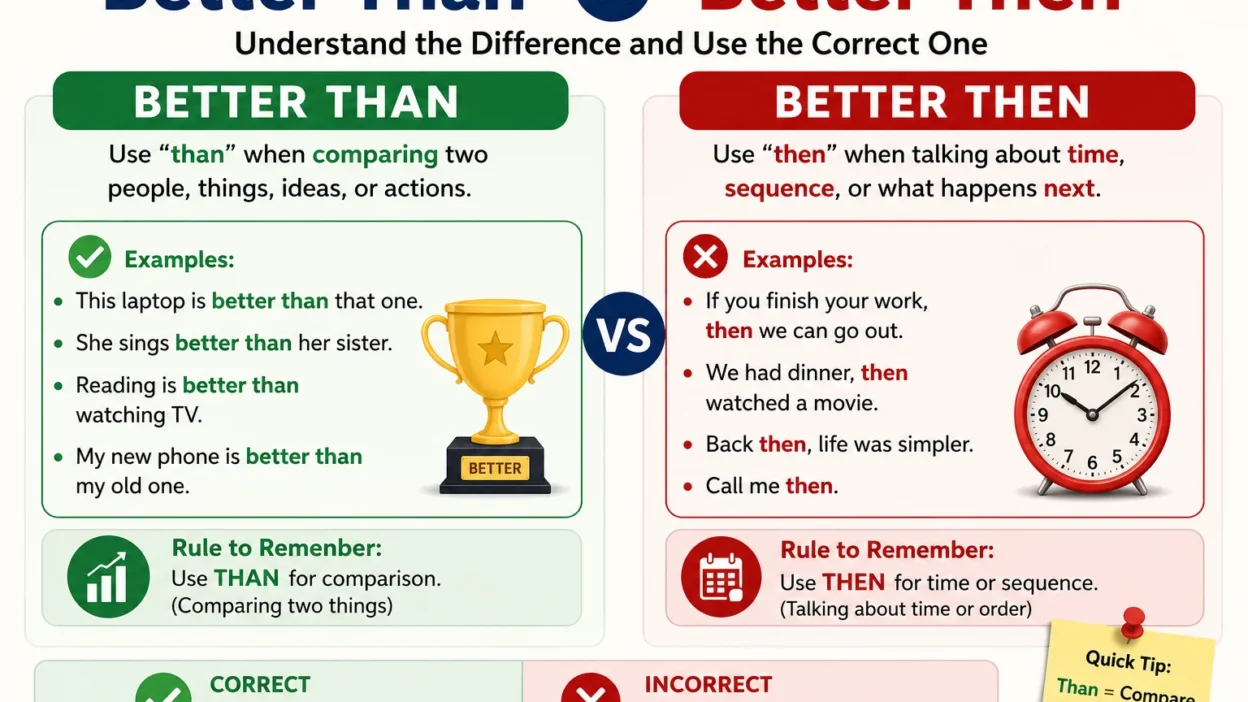
Many English learners confuse better than vs better then because the words than and then look and sound similar.
However, they have completely different meanings and grammar rules. Using the wrong one can change the meaning of your sentence and make your writing look less professional.
Understanding better than vs better then is simple once you know that than is used for comparisons, while then relates to time or sequence.
In this guide, you’ll learn the meanings, differences, grammar rules, examples, common mistakes, memory tricks, and professional usage so you can confidently choose the correct word every time.
Quick Answer
Better than is the correct phrase when comparing two or more things.
Better then is usually incorrect unless then refers to time in a separate context.
Better Than vs Better Then Comparison Table
| Feature | Better Than | Better Then |
|---|---|---|
| Correct for comparisons | ✅ Yes | ❌ No |
| Uses “than” | Comparison | No |
| Uses “then” | No | Time or sequence |
| Common in writing | Yes | Rarely correct |
| Grammar | Correct | Usually incorrect |
What Does “Better Than” Mean?
Better than is used when comparing one person, object, idea, or action with another.
Examples
- This laptop is better than the old one.
- She sings better than her brother.
- Reading is better than watching TV all day.
- My new phone is better than my previous one.
Here, than introduces the second item being compared.
What Does “Better Then” Mean?
Better then is usually incorrect because then refers to time, order, or what happens next—not comparison.
However, it can occasionally appear when then means at that time.
Correct Example
- If you’re feeling better then, we can go hiking.
Here, then refers to a future time.
Incorrect Example
❌ This phone is better then yours.
✅ This phone is better than yours.
Better Than vs Better Then: Key Differences
| Aspect | Better Than | Better Then |
|---|---|---|
| Meaning | Comparison | Time or sequence |
| Grammar | Comparative | Adverb |
| Correct in comparisons | Yes | No |
| Used in essays | Yes | Only in time-related sentences |
| Common mistake | No | Yes |
Why Do People Confuse “Than” and “Then”?
Several reasons make this mistake common.
1. Similar Pronunciation
The two words sound very similar in everyday speech.
2. Similar Spelling
Only one letter differs between them.
3. Fast Typing
People often type then instead of than by accident.
4. Autocorrect Doesn’t Always Catch It
Because both are real English words, spell check may not identify the mistake.
Grammar Rules
Use Than for Comparisons
Examples:
- Faster than
- Bigger than
- Better than
- More interesting than
Use Then for Time or Order
Examples:
- Finish your homework, then play.
- Back then, life was different.
- First eat, then leave.
Grammar Forms Table
| Word | Part of Speech | Main Use | Example |
|---|---|---|---|
| Than | Conjunction/Preposition | Comparison | She is taller than me. |
| Then | Adverb | Time or sequence | We ate, then left. |
When Should You Use “Better Than”?
Use better than whenever comparing:
- Two people
- Two products
- Two ideas
- Two choices
- Two performances
Examples
- Coffee tastes better than tea.
- Online classes are better than expected.
- Prevention is better than cure.
- This solution is better than the previous one.
Real-Life Examples
Business
“Our latest product performs better than last year’s model.”
Education
“Studying every day is better than cramming before exams.”
Science
“The new material is better than traditional plastic.”
Sports
“Our team played better than expected.”
Technology
“This processor is better than the older version.”
Everyday Conversation
“I like summer better than winter.”
Industry Usage Table
| Industry | Example Sentence |
|---|---|
| Business | Our service is better than competitors’. |
| Education | Practical learning is better than memorization alone. |
| Healthcare | Prevention is better than treatment. |
| Technology | Cloud storage is better than local storage for backups. |
| Marketing | Video ads perform better than static images. |
| Sports | Today’s defense was better than last week’s. |
Common Comparison Phrases Using “Than”
| Phrase | Example |
|---|---|
| Better than | Better than before |
| More than | More than enough |
| Less than | Less than expected |
| Rather than | Rather than argue |
| Other than | Other than Monday |
Common Mistakes
Correct vs Incorrect Sentences
| Incorrect | Correct |
|---|---|
| She is better then me. | She is better than me. |
| This option is better then that one. | This option is better than that one. |
| Reading is better then scrolling. | Reading is better than scrolling. |
| He performed better then expected. | He performed better than expected. |
| My car is better then yours. | My car is better than yours. |
Memory Trick
Remember this simple rule:
Than = Compare
Then = Time
An easy reminder:
- Than has the letter A for Comparison (think “Against another”).
- Then has the letter E for Events that happen in order.
If you’re comparing two things, always choose than.
How to Choose the Correct Word
| Situation | Correct Word |
|---|---|
| Comparing two things | Than |
| Talking about time | Then |
| Talking about sequence | Then |
| Comparing people | Than |
| Comparing products | Than |
Professional Writing Tips
In business reports, academic papers, emails, and professional documents, using better than correctly improves clarity and credibility.
Examples:
- Our results are better than projected.
- The revised policy is better than the previous version.
- Customer satisfaction is better than last quarter.
People Also Ask
Is “better then” ever correct?
Yes, but only when then refers to time, such as “If you feel better then, call me.”
Why is “better than” correct?
Because than is the word used to introduce comparisons.
Is “than” a conjunction?
Yes. It commonly functions as a conjunction and sometimes as a preposition in comparisons.
Why do people mix up “than” and “then”?
They look alike, sound similar, and are often mistyped.
Can I use “then” after comparative adjectives?
No. Comparative adjectives like better, faster, smarter, and bigger should normally be followed by than.
Frequently Asked Questions
Which is grammatically correct: better than or better then?
Better than is correct for comparisons.
Does “then” mean after that?
Yes. Then refers to time, sequence, or what happens next.
Is “better than expected” correct?
Yes. It is a common and grammatically correct expression.
Can “then” replace “than”?
No. They have different meanings and cannot usually replace each other.
What is the easiest way to remember the difference?
Use than for comparisons and then for time or sequence.
Conclusion
The difference between better than vs better then is straightforward. Use better than whenever you’re comparing two people, things, ideas, or situations.
Use then only when referring to time or the order of events. Remember the simple rule: than compares, then tells time. Following this guideline will help you avoid one of the most common grammar mistakes in English and make your writing more accurate and professional.

Julian Wyatt is a passionate researcher and writer who explores symbols, mythology, cultural traditions, and hidden meanings. Through engaging articles, he helps readers uncover the fascinating stories and significance behind symbols worldwide.