The debate over unalienable vs inalienable often confuses English learners, writers, and even native speakers.
Since both words appear in legal, historical, and philosophical texts, many people wonder if there is a real difference between unalienable vs inalienable or if they simply mean the same thing.
Understanding their meaning and usage helps you choose the right word with confidence.
In modern English, unalienable vs inalienable is mostly a matter of style rather than meaning.
Both describe rights or possessions that cannot be taken away or transferred.
However, one term is more common in historical documents, while the other is preferred in modern legal writing.
This guide explains their meaning, differences, examples, grammar, and correct usage in simple English.
Quick Answer
Unalienable and inalienable mean the same thing: something that cannot legally or morally be taken away, transferred, or surrendered.
Today, inalienable is more common in modern English, while unalienable is famous because it appears in the United States Declaration of Independence.
Main Comparison Table
| Feature | Unalienable | Inalienable |
|---|---|---|
| Meaning | Cannot be taken away or transferred | Cannot be taken away or transferred |
| Modern Usage | Less common | More common |
| Historical Importance | Very famous | Widely used |
| Legal Writing | Occasionally | Frequently |
| Everyday English | Rare | Preferred |
| Correct? | Yes | Yes |
What Does “Unalienable” Mean?
Unalienable is an adjective describing something that cannot be transferred, removed, sold, or given away.
It is most often associated with natural human rights.
Examples
- Every person has unalienable rights.
- Freedom is considered an unalienable right.
- Human dignity is often described as unalienable.
What Does “Inalienable” Mean?
Inalienable has exactly the same meaning as unalienable.
It is the preferred spelling in modern legal, academic, and professional English.
Examples
- Education is considered an inalienable human right in many countries.
- Every citizen possesses inalienable freedoms.
- Human rights are inalienable.
Unalienable vs Inalienable: What’s the Difference?
Although people search for the difference between unalienable vs inalienable, there is virtually no difference in meaning.
The distinction lies mainly in style and historical preference.
| Comparison | Unalienable | Inalienable |
|---|---|---|
| Meaning | Same | Same |
| Pronunciation | Same | Same |
| Historical Use | More famous | Common |
| Modern Preference | Less common | More common |
| Accepted English | Yes | Yes |
Why Does the Declaration of Independence Use “Unalienable”?
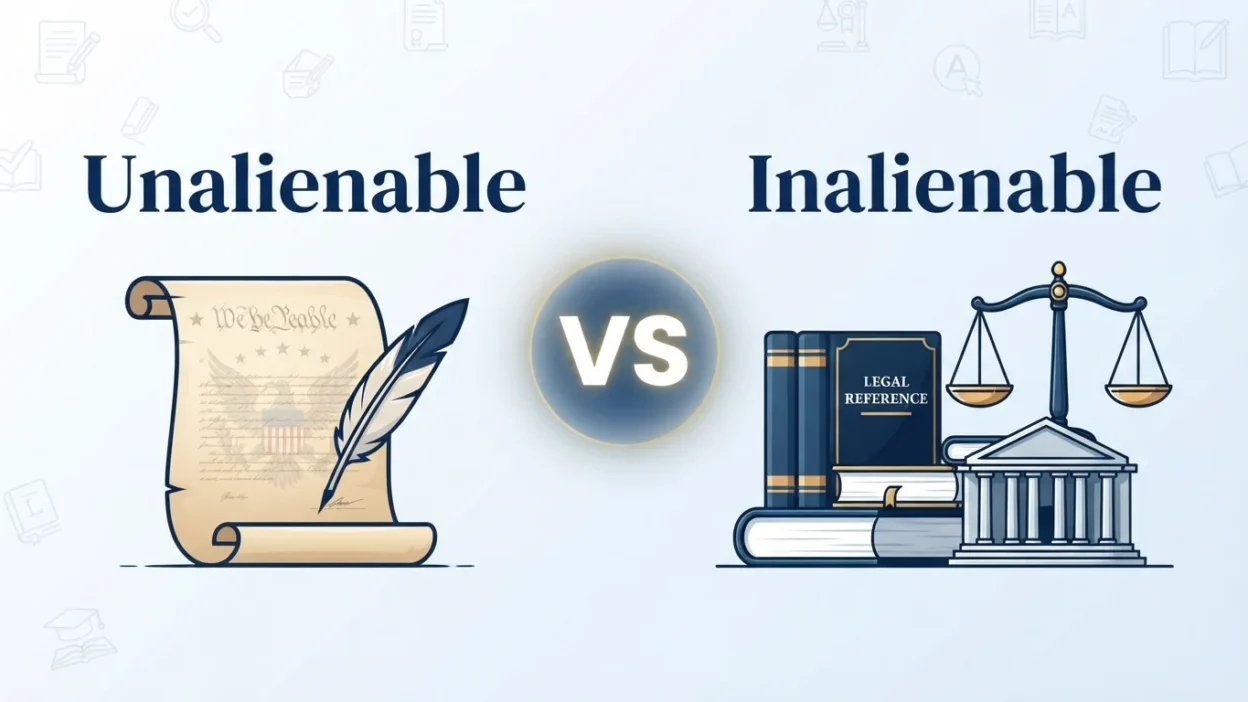
One reason unalienable remains well known is because it appears in the United States Declaration of Independence, which states:
“…that all men are created equal… endowed… with certain unalienable Rights…”
The wording has remained unchanged since 1776, preserving the historical spelling.
When Should You Use Each Word?
Choose inalienable when writing:
- Academic papers
- Business documents
- Legal discussions
- News articles
- Professional reports
Choose unalienable when referring to:
- Historical texts
- The Declaration of Independence
- Discussions of political philosophy
- Historical quotations
Usage Guide
| Situation | Best Choice |
|---|---|
| History class | Unalienable |
| Legal contract | Inalienable |
| Academic writing | Inalienable |
| Newspaper | Inalienable |
| Historical quotation | Unalienable |
Grammar Forms
Both words function as adjectives.
Grammar Table
| Form | Example |
|---|---|
| Adjective | Inalienable rights |
| Adjective | Unalienable freedoms |
| Before noun | Inalienable liberty |
| Predicate adjective | These rights are inalienable. |
Neither word has comparative or superlative forms because they describe an absolute quality.
Real-Life Examples
Business
- Intellectual property may include certain inalienable moral rights.
- Some employee rights are legally inalienable.
Education
- Many educators believe every child has an inalienable right to education.
- Equal learning opportunities are considered inalienable by many organizations.
Government
- Governments are expected to protect inalienable rights.
- Political philosophers discuss unalienable rights extensively.
Science and Ethics
- Medical ethics recognizes inalienable human dignity.
- Ethical research respects inalienable personal rights.
Everyday Conversation
- Everyone deserves inalienable respect.
- Freedom of thought is often called an unalienable right.
Professional and Industry Usage
Modern professionals overwhelmingly prefer inalienable.
Industry Usage Table
| Industry | Preferred Word | Reason |
|---|---|---|
| Law | Inalienable | Modern legal terminology |
| Education | Inalienable | Academic standard |
| Government | Both | Depends on context |
| History | Unalienable | Historical accuracy |
| Journalism | Inalienable | Contemporary style |
| Human Rights | Inalienable | International usage |
Why People Confuse Unalienable and Inalienable
Several reasons explain the confusion.
- Both words have identical meanings.
- They differ by only one prefix.
- Both are grammatically correct.
- Historical documents popularized one version.
- Modern dictionaries recognize both spellings.
Common Mistakes
Common Errors Table
| Incorrect | Correct |
|---|---|
| Unalienable means transferable. | Unalienable means not transferable. |
| Inalienable is incorrect. | Inalienable is correct. |
| Only unalienable is accepted. | Both are accepted. |
| They have different meanings. | Their meanings are essentially identical. |
Correct vs Incorrect Sentences
❌ Freedom is an alienable right.
✅ Freedom is an inalienable right.
❌ Human rights are untransferable because they are alienable.
✅ Human rights are inalienable.
❌ Only unalienable is correct English.
✅ Both unalienable and inalienable are correct.
Memory Trick
Remember this simple tip:
- Inalienable = In modern English
- Unalienable = Used in the U.S. Declaration of Independence
If you’re writing something modern, inalienable is usually the safer choice.
Similar Words
| Word | Meaning |
|---|---|
| Fundamental | Basic and essential |
| Inherent | Existing naturally |
| Intrinsic | Belonging naturally |
| Absolute | Not limited |
| Essential | Necessary and fundamental |
How to Choose the Right Word
Follow these steps.
Decision Table
| Step | Question | Recommendation |
|---|---|---|
| 1 | Is it a historical quotation? | Use unalienable |
| 2 | Is it legal writing? | Use inalienable |
| 3 | Is it academic writing? | Use inalienable |
| 4 | Is it general English? | Use inalienable |
| 5 | Referring to the Declaration? | Keep unalienable |
Frequently Asked Questions
Is there a difference between unalienable and inalienable?
No. Their meanings are essentially identical. The difference is mainly historical and stylistic.
Which word is more common today?
Inalienable is much more common in modern English.
Why does the Declaration of Independence use unalienable?
It reflects the language style used when the document was written in 1776.
Can I use either word?
Yes. Both are correct, although inalienable is preferred in most modern writing.
Which spelling should students use?
Students should generally use inalienable, unless quoting historical documents.
Conclusion
Understanding unalienable vs inalienable is easier than it first appears. Both words share the same meaning and describe rights or qualities that cannot be taken away or transferred.
The primary difference is usage: unalienable is historically significant because of the Declaration of Independence,
while inalienable is the standard choice in modern legal, academic, and everyday English. When in doubt, use inalienable for contemporary writing and reserve unalienable for historical references or direct quotations.