The grammar question she has vs she have is one of the most common mistakes made by English learners.
Although both phrases contain the verb have, only one is grammatically correct with the subject she. Understanding the difference between she has vs she have will help you write and speak more naturally in both formal and everyday English.
If you’ve ever wondered if to say “she has finished her homework” or “she have finished her homework,” this guide is for you.
We’ll explain the she has vs she have meaning, grammar rules, examples, common mistakes, and usage tips in simple English so you can avoid this error with confidence.
Quick Answer
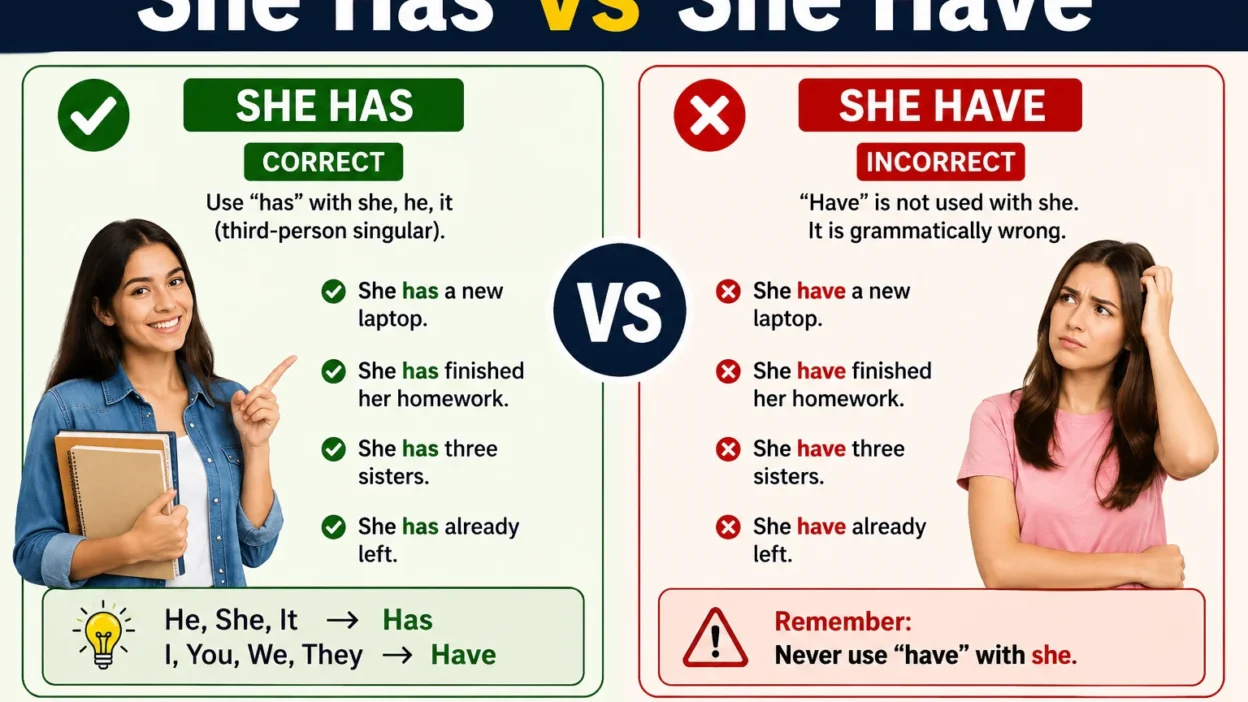
“She has” is the correct form because she is a third-person singular subject.
“She have” is incorrect in standard English, except in very limited cases such as the subjunctive mood or certain non-standard dialects.
What Does “She Has” Mean?
She has combines the subject she with the third-person singular form of the verb have.
It can express:
- Possession
- Present perfect tense
- Experience
- Obligation (in some expressions)
Examples
- She has a new laptop.
- She has completed the project.
- She has three sisters.
- She has already left.
What Does “She Have” Mean?
In standard English, she have is grammatically incorrect.
The verb have is used with:
- I
- You
- We
- They
It does not normally follow she, he, or it.
Incorrect Example
❌ She have a car.
Correct Form
✅ She has a car.
She Has vs She Have: Main Difference
| Feature | She Has | She Have |
|---|---|---|
| Grammar | Correct | Incorrect (standard English) |
| Subject | She | She |
| Verb Form | Has | Have |
| Standard English | Yes | No |
| Common Usage | Everyday English | Rare exceptions only |
Comparison Table
| Category | She Has | She Have |
|---|---|---|
| Correctness | Correct | Incorrect |
| Present tense | Yes | No |
| Present perfect | Yes | No |
| Formal writing | Yes | No |
| Spoken English | Yes | Rare in standard English |
Why Is “She Has” Correct?
English verbs change depending on the subject.
For third-person singular subjects, the verb have changes to has.
Third-person singular subjects include:
- He
- She
- It
- John
- Sarah
- The company
Examples
- She has a dog.
- He has a meeting.
- It has stopped raining.
When Do We Use “Have”?
Use have with these subjects:
| Subject | Correct Form |
|---|---|
| I | Have |
| You | Have |
| We | Have |
| They | Have |
| She | Has |
| He | Has |
| It | Has |
Examples
- I have a question.
- They have finished.
- We have enough time.
- She has arrived.
She Has in Different Tenses
| Tense | Example |
|---|---|
| Simple Present | She has a bicycle. |
| Present Perfect | She has finished the report. |
| Present Perfect Continuous | She has been studying all day. |
| Possession | She has blue eyes. |
Real-Life Examples
Business
- She has accepted the job offer.
- She has managed the team successfully.
Education
- She has completed her assignment.
- She has excellent grades.
Science
- The researcher has published a new study.
- She has discovered an important pattern.
Daily Life
- She has a beautiful garden.
- She has already eaten dinner.
Industry Usage Table
| Industry | Example |
|---|---|
| Business | She has signed the contract. |
| Education | She has passed the examination. |
| Healthcare | She has recovered well. |
| Technology | She has updated the software. |
| Journalism | She has released a statement. |
Grammar Forms Table
| Subject | Present Form | Example |
|---|---|---|
| I | Have | I have a car. |
| You | Have | You have a ticket. |
| We | Have | We have enough money. |
| They | Have | They have arrived. |
| He | Has | He has a laptop. |
| She | Has | She has a book. |
| It | Has | It has a tail. |
How to Choose the Correct Form
| Situation | Correct Choice |
|---|---|
| Talking about a woman | She has |
| Present perfect tense | She has |
| Showing possession | She has |
| Formal writing | She has |
| Everyday conversation | She has |
Why Do People Confuse “She Has” and “She Have”?
Several reasons explain this common mistake:
- Learners memorize have as the base verb.
- Many languages do not change verbs for different subjects.
- Fast speech can make grammar harder to notice.
- Beginners often overuse the base form.
- Translation from other languages may cause confusion.
Common Mistakes
| Incorrect Sentence | Correct Sentence |
|---|---|
| She have a dog. | She has a dog. |
| She have finished her work. | She has finished her work. |
| She have many friends. | She has many friends. |
| She have gone home. | She has gone home. |
Correct vs Incorrect Usage
Correct
- She has completed the course.
- She has two children.
- She has worked here for five years.
- She has called you twice.
Incorrect
- She have completed the course.
- She have two children.
- She have worked here for five years.
- She have called you twice.
Memory Trick
Remember this simple rule:
He, She, It → Has
I, You, We, They → Have
If the sentence starts with she, always think has, not have.
Special Grammar Note
Although she have is incorrect in standard English, it may appear in:
- Certain regional dialects
- Song lyrics
- Informal speech
- Older literary works
In formal writing, always use she has.
People Also Ask
Is “she have” ever correct?
In standard English, no. Use she has instead. “She have” may appear only in certain dialects or special grammatical situations.
Why do we say “she has” instead of “she have”?
Because has is the correct third-person singular form of the verb have.
Is “she has” present tense?
Yes. It is the simple present form and is also used to form the present perfect tense.
Can “she has” show possession?
Yes. For example, She has a new phone shows possession.
Which is more common: “she has” or “she have”?
She has is the only correct and common form in standard English.
Conclusion
Understanding she has vs she have is simple once you know the basic grammar rule. The subject she always takes has in standard English because it is third-person singular.
The phrase she have is considered incorrect in normal writing and speech, except in a few dialects or special grammatical contexts.
Whenever you write or speak about one woman or girl, remember the easy rule. Following this rule will make your English clearer, more accurate, and more natural.