The elegy vs eulogy comparison often confuses English learners because both words are connected with death, remembrance, and honoring someone who has passed away.
Although they share a similar emotional purpose, they are used in completely different situations. Understanding the elegy vs eulogy difference helps you choose the correct word in writing, speeches, literature, and everyday conversations.
If you’ve ever wondered if an emotional funeral speech is an elegy or a eulogy, or whether a poem mourning someone’s death should be called a eulogy, you’re not alone.
This guide explains the elegy vs eulogy meaning, usage, examples, grammar, and common mistakes in simple English.
Quick Answer
The difference between elegy vs eulogy is simple:
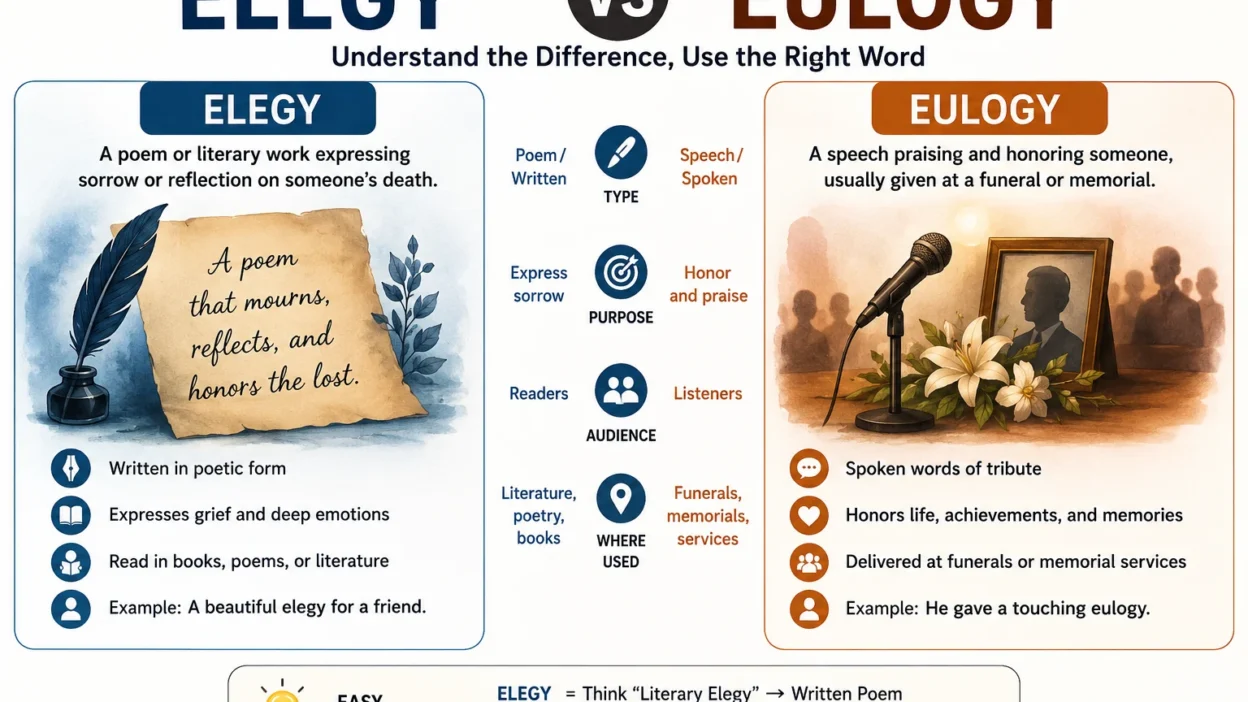
- Elegy is a poem or literary work expressing sorrow for someone who has died.
- Eulogy is a speech praising and honoring someone, usually delivered at a funeral.
An elegy is written literature, while a eulogy is spoken tribute.
Elegy vs Eulogy Comparison Table
| Feature | Elegy | Eulogy |
|---|---|---|
| Meaning | A poem mourning someone’s death | A speech honoring someone’s life |
| Form | Written | Spoken |
| Purpose | Express grief and reflection | Celebrate and remember the deceased |
| Usually Given | In literature or poetry | At funerals or memorial services |
| Tone | Sad, reflective | Respectful, appreciative |
| Audience | Readers | Funeral attendees |
| Example | A poem remembering a loved one | A speech by a family member |
What Does “Elegy” Mean?
An elegy is a poem or literary composition that expresses sorrow, mourning, or reflection after someone’s death. Modern elegies may also mourn the loss of places, ideas, or important moments.
Examples
- The poet wrote an elegy for his late wife.
- The collection includes several moving elegies.
- Her elegy beautifully captured the family’s grief.
Common Characteristics
- Written in poetic form
- Emotional and reflective
- Focuses on loss
- Often ends with hope or acceptance
What Does “Eulogy” Mean?
A eulogy is a speech that praises and honors a person who has died. It is commonly delivered by a family member, friend, or religious leader during a funeral or memorial service.
Examples
- His daughter delivered a touching eulogy.
- The minister gave a heartfelt eulogy.
- Everyone appreciated her sincere eulogy.
Common Characteristics
- Spoken aloud
- Honors achievements and character
- Often includes personal memories
- Delivered at funerals or memorials
Key Differences Between Elegy and Eulogy
| Aspect | Elegy | Eulogy |
|---|---|---|
| Type | Literary work | Speech |
| Medium | Written | Spoken |
| Main Goal | Express grief | Honor a person’s life |
| Typical Writer | Poet | Family member, friend, clergy |
| Where Used | Books, poems, literature | Funeral services |
| Style | Artistic | Conversational |
When Should You Use Elegy?
Use elegy when referring to poetry or literary writing about loss or death.
Correct Examples
- The famous poet composed an elegy after the tragedy.
- Students studied Milton’s elegy in literature class.
- The magazine published an elegy honoring the scientist.
When Should You Use Eulogy?
Use eulogy when referring to a speech delivered in memory of someone who has died.
Correct Examples
- She gave a moving eulogy at the memorial.
- His eulogy highlighted years of community service.
- The family prepared a heartfelt eulogy.
Real-Life Examples in Different Contexts
| Context | Elegy | Eulogy |
|---|---|---|
| Literature | A poem mourning a famous author | Not commonly used |
| Funeral | Occasionally printed in programs | Main memorial speech |
| Education | Students analyze famous elegies | Students practice speech writing |
| Religion | Religious poetry | Funeral sermon or tribute |
| History | Historical mourning poems | Memorial speeches for leaders |
Business
A company newsletter may publish an elegy-like tribute after the passing of a founder, while a CEO may deliver a eulogy during the memorial ceremony.
Education
English students read elegies in poetry classes, while speech classes may teach how to write respectful eulogies.
Science
Scientific organizations sometimes publish written tributes similar to elegies, while colleagues deliver eulogies at remembrance events.
Why Do People Confuse Elegy and Eulogy?
Many people confuse these words because:
- Both relate to death.
- Both honor someone who has passed away.
- Both express respect and remembrance.
- Their pronunciation is somewhat similar.
- They are often used around funerals.
The easiest distinction is:
Elegy = Written poem
Eulogy = Spoken speech
Grammar Forms
| Word | Part of Speech | Example |
|---|---|---|
| Elegy | Noun | The elegy moved everyone. |
| Elegiac | Adjective | The poem has an elegiac tone. |
| Elegist | Noun | The elegist wrote about loss. |
| Eulogy | Noun | His eulogy honored her life. |
| Eulogize | Verb | Friends gathered to eulogize him. |
| Eulogist | Noun | The eulogist spoke warmly. |
Professional and Industry Usage
| Industry | Elegy | Eulogy |
|---|---|---|
| Literature | Frequently used | Rare |
| Publishing | Common in poetry collections | Occasionally in biographies |
| Funeral Services | Sometimes printed | Commonly delivered |
| Education | Literature courses | Public speaking courses |
| Religious Organizations | Less common | Very common |
| Journalism | Memorial articles | Reports on funeral speeches |
Process: Choosing the Correct Word
| Situation | Correct Word |
|---|---|
| Writing a mourning poem | Elegy |
| Speaking at a funeral | Eulogy |
| Studying poetry | Elegy |
| Giving a memorial speech | Eulogy |
| Reading classic literature | Elegy |
| Remembering someone’s achievements aloud | Eulogy |
Memory Trick
Remember this simple trick:
| Word | Memory Tip |
|---|---|
| Elegy | Think Literary Elegy = Written poem |
| Eulogy | Think You Speak a Eulogy = Funeral speech |
Another way to remember:
- Elegy = Expression through poetry
- Eulogy = Expression through speech
Common Mistakes
Many learners accidentally replace one word with the other.
| Incorrect | Correct |
|---|---|
| She delivered an elegy at the funeral. | She delivered a eulogy at the funeral. |
| The poet published a beautiful eulogy. | The poet published a beautiful elegy. |
| We studied eulogies in poetry class. | We studied elegies in poetry class. |
| His elegy praised her achievements during the funeral speech. | His eulogy praised her achievements during the funeral speech. |
Correct vs Incorrect Sentences
| Incorrect Sentence | Correct Sentence |
|---|---|
| He wrote a eulogy about the war. | He wrote an elegy about the war. |
| The minister read an elegy during the funeral speech. | The minister gave a eulogy during the funeral service. |
| Shakespeare gave a eulogy. | Shakespeare wrote elegies. |
| She composed a spoken elegy. | She delivered a eulogy. |
People Also Ask
Is an elegy the same as a eulogy?
No. An elegy is a written poem, while a eulogy is a spoken funeral speech.
Can a eulogy be written?
Yes. Most eulogies are written beforehand but are intended to be spoken during a memorial service.
Is every funeral speech a eulogy?
Most speeches honoring the deceased at funerals are considered eulogies.
Can an elegy be about something other than death?
Yes. Modern elegies may express sorrow over the loss of places, relationships, or ideals.
Which comes first at a funeral, the elegy or the eulogy?
A eulogy is commonly delivered during the funeral. An elegy may be read or printed but is not a required part of the ceremony.
FAQs
What is the main difference between elegy and eulogy?
An elegy is a poem expressing grief, while a eulogy is a speech honoring someone’s life.
Is a eulogy always spoken?
Yes. Although it is usually written first, its purpose is to be delivered aloud.
Can an elegy be written for someone still alive?
Yes. Some modern elegies mourn lost opportunities, places, or stages of life rather than death.
Which word is more common in everyday English?
Eulogy is more common because people frequently discuss funerals and memorial services.
Can an elegy be read at a funeral?
Yes. An elegy can be read during a funeral, but it remains a poem rather than a eulogy.
Conclusion
Understanding elegy vs eulogy is straightforward once you know their purpose. An elegy is a written poem that mourns loss and expresses grief, while a eulogy is a spoken tribute celebrating a person’s life at a funeral or memorial service.
Whenever you’re talking about literature, poetry, or artistic reflection, use elegy. When referring to a funeral speech honoring someone, use eulogy. Remember this simple rule: Elegy equals poetry, and eulogy equals speech.
Choosing the correct word will make your writing and communication more accurate and natural.