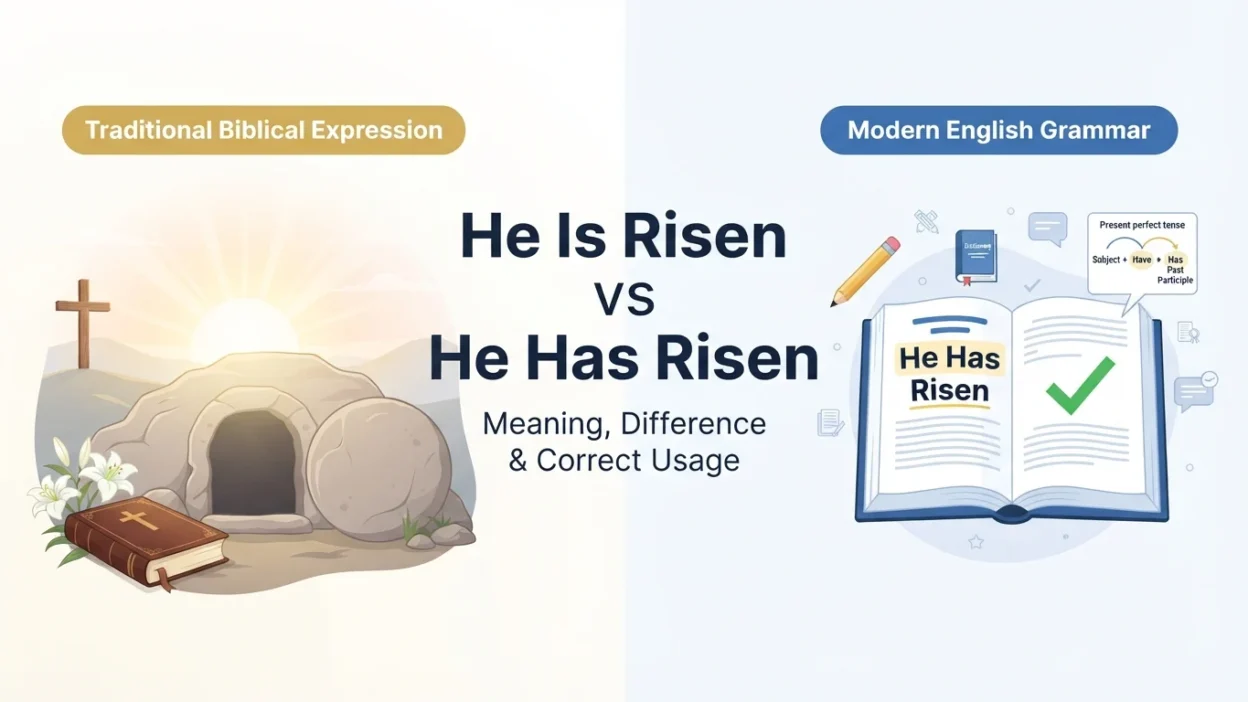
Many people wonder about he is risen vs he has risen, especially around Easter when the phrase “
He is risen” appears in church services, greeting cards, and religious celebrations.
At first glance, he is risen vs he has risen may seem like a simple grammar question, but the answer involves both modern English grammar and historical religious language.
Understanding he is risen vs he has risen helps you know when each expression is appropriate.
While he has risen follows modern English grammar, he is risen is a traditional biblical expression that has remained an important part of Christian worship for centuries. This guide explains their meanings, differences, examples, grammar, and correct usage.
Quick Answer
He has risen is the grammatically standard form in modern English because rise normally takes the auxiliary verb has.
He is risen is an older biblical expression that remains correct in religious, liturgical, and traditional Christian contexts.
He Is Risen vs He Has Risen at a Glance
| Feature | He Is Risen | He Has Risen |
|---|---|---|
| Modern Grammar | Not standard | Standard |
| Religious Usage | Very common | Also correct |
| Biblical Style | Traditional | Modern translations |
| Everyday English | Rare | Correct |
| Easter Greeting | Yes | Less common |
What Does “He Is Risen” Mean?
He is risen is a traditional Christian declaration celebrating the resurrection of Jesus Christ.
The phrase originated from older forms of English, where some verbs commonly used be as the helping verb instead of have.
Today, it remains one of Christianity’s most recognizable Easter greetings.
Examples
- He is risen indeed!
- Christians celebrate the message that He is risen.
- The church displayed a banner reading, “He is risen.”
What Does “He Has Risen” Mean?
He has risen is the grammatically standard present perfect form in modern English.
It communicates that someone has risen, emphasizing the completed action with present relevance.
Examples
- He has risen from the dead.
- The sun has risen above the mountains.
- The athlete has risen to fame.
Main Difference Between He Is Risen and He Has Risen
The biggest difference is grammatical style and context.
| Aspect | He Is Risen | He Has Risen |
|---|---|---|
| Grammar Style | Historical English | Modern English |
| Auxiliary Verb | Is | Has |
| Main Context | Christian tradition | Everyday grammar |
| Formal Writing | Religious only | General English |
| Common Today | Church settings | Modern writing |
Why Is “He Is Risen” Still Used?
Although it doesn’t follow today’s standard grammar, He is risen has been preserved because of its historical and religious significance.
The phrase appears in older English Bible translations and centuries of Christian worship.
It has become a fixed expression rather than an example of everyday grammar.
Grammar Behind Both Expressions
Modern English uses have as the auxiliary verb for rise.
Grammar Forms
| Tense | Example |
|---|---|
| Present | He rises. |
| Past | He rose. |
| Present Perfect | He has risen. |
| Past Perfect | He had risen. |
| Future Perfect | He will have risen. |
Historical Grammar
| Older English | Modern English |
|---|---|
| He is risen. | He has risen. |
| Christ is risen. | Christ has risen. |
When Should You Use “He Is Risen”?
Use He is risen in:
- Easter greetings
- Church services
- Religious songs
- Christian literature
- Traditional prayers
- Biblical quotations
Examples
- He is risen indeed!
- The pastor proclaimed, “He is risen.”
- Easter banners often display “He is risen.”
When Should You Use “He Has Risen”?
Use He has risen in normal English writing when describing the completed action of rising.
Examples
- He has risen early every morning this week.
- The balloon has risen into the sky.
- The company’s profits have risen significantly.
- Jesus has risen from the dead.
Real-Life Examples
Religious Context
| Expression | Example |
|---|---|
| He is risen | He is risen indeed! |
| He has risen | Jesus has risen from the dead. |
Education
| Expression | Example |
|---|---|
| He is risen | Students learned why the phrase is traditional. |
| He has risen | Students practiced present perfect grammar. |
Literature
| Expression | Example |
|---|---|
| He is risen | Used in historical religious texts. |
| He has risen | Used in modern English translations. |
Everyday English
| Expression | Example |
|---|---|
| He is risen | Rare outside religion. |
| He has risen | The sun has risen already. |
Professional and Industry Usage
| Industry | He Is Risen | He Has Risen |
|---|---|---|
| Churches | Standard | Accepted |
| Bible Translation | Traditional versions | Modern versions |
| Education | Historical example | Grammar teaching |
| Journalism | Religious reporting | General reporting |
| Publishing | Religious books | Everyday writing |
Why Do People Confuse He Is Risen and He Has Risen?
There are several reasons.
- Both describe the same event.
- Older English used be with certain verbs.
- Easter celebrations popularize the traditional phrase.
- Modern grammar teaches have risen.
- Bible translations differ in wording.
Memory Trick
Remember this simple rule.
| Expression | Memory Trick |
|---|---|
| He is risen | Think church, Easter, tradition. |
| He has risen | Think modern English grammar. |
If you’re writing an email, essay, or article, choose he has risen unless you’re intentionally quoting or using the traditional Easter greeting.
Common Mistakes
Incorrect vs Correct
| Incorrect | Correct |
|---|---|
| He is risen early today. | He has risen early today. |
| The sun is risen. | The sun has risen. |
| Easter greeting: He has rose. | Easter greeting: He is risen. |
| He has rose from the dead. | He has risen from the dead. |
Step-by-Step Guide to Choosing the Correct Expression
| Step | Question | Use |
|---|---|---|
| 1 | Is this an Easter greeting? | He is risen |
| 2 | Is it religious worship? | He is risen |
| 3 | Is it modern English grammar? | He has risen |
| 4 | Is it everyday conversation? | He has risen |
People Also Ask
Is “He is risen” grammatically correct?
In modern grammar, he has risen is standard. However, He is risen is correct as a traditional religious expression.
Why do Christians say “He is risen”?
Because it is a centuries-old Easter proclamation preserved in Christian worship and tradition.
Can I say “He has risen” at Easter?
Yes. It is grammatically correct, although He is risen remains the traditional greeting.
Which expression appears in modern Bible translations?
Many modern translations use He has risen, while traditional liturgy often keeps He is risen.
Frequently Asked Questions
Which is more common today?
Outside religious settings, he has risen is more common.
Is “He is risen indeed” still correct?
Yes. It remains the traditional Easter response used worldwide.
Why does older English use “is” instead of “has”?
Earlier forms of English often used be as the helping verb with verbs of movement like rise.
Should I correct someone who says “He is risen”?
No. In religious contexts, it is an accepted traditional expression.
Which should students use in school essays?
Unless discussing religious tradition or quoting scripture, students should generally use he has risen.
Conclusion
Understanding he is risen vs he has risen requires recognizing the difference between historical tradition and modern English grammar. He has risen is the standard present perfect form used in everyday English, while He is risen is a timeless Christian proclamation that has survived through centuries of worship and biblical tradition.
If you’re writing ordinary English, use he has risen. If you’re celebrating Easter, quoting scripture, or participating in Christian worship, He is risen is both appropriate and meaningful.