The phrase finger in the dike meaning often confuses English learners because it sounds literal, yet it is actually an idiom.
Many people wonder whether it refers to a real historical event or simply symbolizes preventing a disaster.
Understanding the finger in the dike meaning helps you use this expression naturally in conversations, writing, and professional discussions.
Although the phrase comes from a famous story, its modern usage is mostly figurative. Today, the finger in the dike meaning refers to making a temporary effort to stop a much larger problem until a permanent solution can be be found.
This guide explains its meaning, origin, examples, grammar, and common mistakes.
Quick Answer
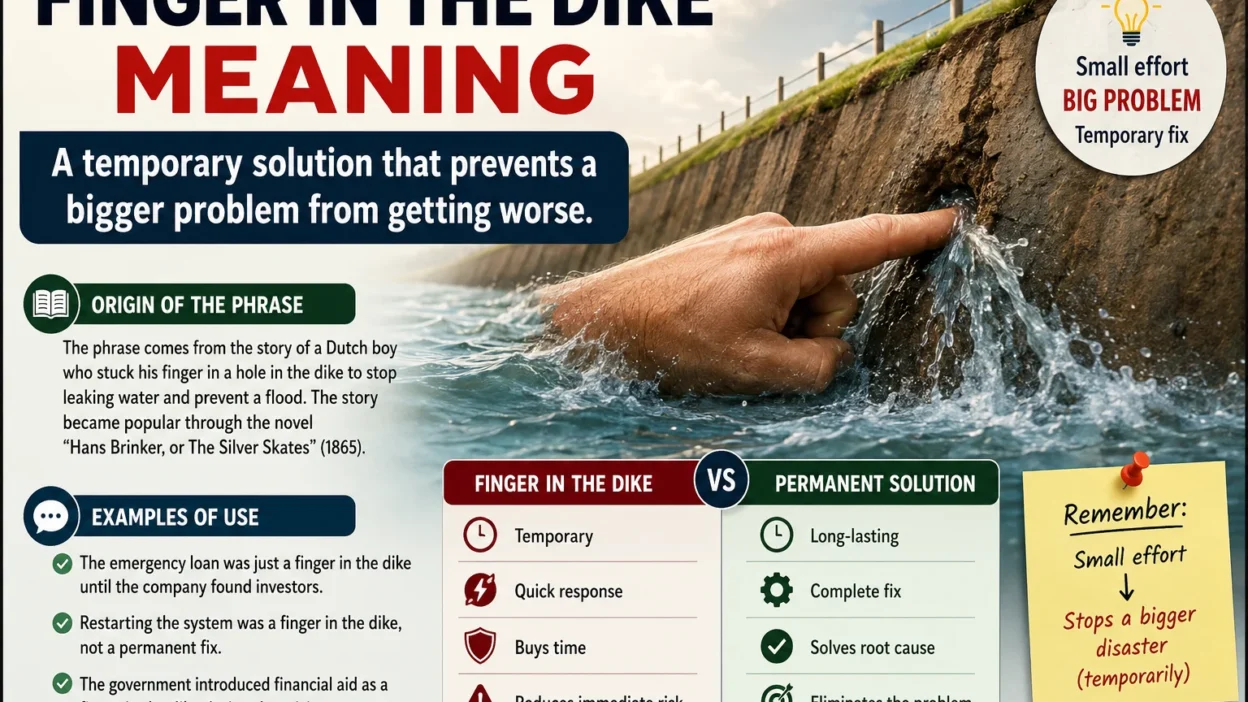
Finger in the dike is an English idiom that means a temporary action taken to prevent a bigger problem from getting worse.
It describes a short-term fix rather than a permanent solution.
Finger in the Dike Meaning
The idiom finger in the dike means making a small effort that temporarily prevents a major disaster or serious problem.
It is often used when someone is trying to control a difficult situation with limited resources or a temporary solution.
Simple Definition
| Term | Meaning |
|---|---|
| Finger in the dike | A temporary solution that prevents a larger problem from becoming worse |
| Figurative meaning | Holding back trouble until a better solution is available |
Example Sentences
- The extra funding was just a finger in the dike until the company found investors.
- Restarting the server was a finger in the dike, not a permanent fix.
- The government introduced emergency measures as a finger in the dike during the crisis.
- Hiring temporary workers was a finger in the dike while the company searched for permanent employees.
Origin of the Phrase
The expression comes from the famous story of a Dutch boy who noticed a leak in a dike and placed his finger into the hole to stop water from flooding the town.
Although many people believe this is an old Dutch legend, the story actually became popular through the American novel Hans Brinker, or The Silver Skates written by Mary Mapes Dodge in 1865.
Over time, the story inspired the idiom we use today.
Is the Story True?
Interestingly, historians say there is no evidence that the famous story actually happened.
The idiom survives because it perfectly illustrates the idea of preventing disaster with a quick temporary action.
Main Meaning Comparison Table
| Feature | Finger in the Dike |
|---|---|
| Type | Idiom |
| Meaning | Temporary solution |
| Usage | Informal and formal English |
| Literal or figurative | Mostly figurative |
| Purpose | Prevent a problem from becoming worse |
| Permanent solution? | No |
When to Use “Finger in the Dike”
Use this idiom when:
- A temporary solution buys time.
- A major problem cannot yet be fully solved.
- Emergency action prevents greater damage.
- A short-term fix keeps things under control.
Examples
Business
“The emergency loan was only a finger in the dike before long-term financing arrived.”
Technology
“Restarting the application was just a finger in the dike until developers fixed the software.”
Healthcare
“The medication relieved symptoms but acted only as a finger in the dike.”
Education
“The substitute teacher was a finger in the dike until the school hired a permanent instructor.”
When Not to Use the Idiom
Avoid using it when:
- The solution is permanent.
- The problem has already been completely solved.
- You are describing literal flood protection unless you truly mean someone physically plugging a leak.
Incorrect Example
The new bridge is a finger in the dike.
(This is incorrect if the bridge permanently solves the transportation issue.)
Better Example
The temporary repair was a finger in the dike until engineers rebuilt the bridge.
Real-Life Examples Across Different Industries
| Industry | Example |
|---|---|
| Business | Temporary funding prevents bankruptcy |
| Education | Hiring substitute teachers |
| Healthcare | Emergency treatment before surgery |
| IT | Restarting systems before permanent repair |
| Government | Emergency financial aid during disasters |
| Construction | Temporary support structures |
Finger in the Dike vs Permanent Solution
| Finger in the Dike | Permanent Solution |
|---|---|
| Temporary | Long-lasting |
| Quick response | Complete fix |
| Buys time | Solves root cause |
| Reduces immediate risk | Eliminates the problem |
Grammar and Usage Forms
| Form | Example |
|---|---|
| Singular noun phrase | It was a finger in the dike. |
| With articles | A finger in the dike |
| Past tense | The repair was a finger in the dike. |
| Present tense | This measure is a finger in the dike. |
| Future tense | It will be a finger in the dike until upgrades arrive. |
Process Behind the Idiom
| Step | Action |
|---|---|
| 1 | A serious problem appears |
| 2 | Immediate temporary action is taken |
| 3 | The situation stabilizes |
| 4 | A permanent solution is planned |
| 5 | The long-term fix replaces the temporary one |
Why People Misunderstand the Phrase
Many learners misunderstand the idiom because:
- It sounds like a literal expression.
- They assume it refers to actual flood control.
- They do not know the famous story behind it.
- They confuse a temporary fix with a complete solution.
Once you understand its figurative meaning, the expression becomes much easier to recognize.
Common Mistakes
| Incorrect | Correct |
|---|---|
| The repair permanently fixed everything, so it was a finger in the dike. | The repair temporarily controlled the problem, so it was a finger in the dike. |
| A finger on the dike | A finger in the dike |
| Finger into the dike | Finger in the dike |
| Used for permanent solutions | Used for temporary solutions |
Correct vs Incorrect Sentences
❌ The new highway is a finger in the dike because traffic problems disappeared forever.
✅ The temporary traffic plan was a finger in the dike until the highway opened.
❌ The software update permanently solved every issue, making it a finger in the dike.
✅ Restarting the software was a finger in the dike until developers released the update.
Memory Trick
Remember this simple rule:
Finger = Small effort
Dike = Large problem
Together they mean:
A small temporary action that prevents a much bigger disaster.
Professional Usage
The idiom appears in professional writing, especially when discussing temporary measures.
| Field | Example Usage |
|---|---|
| Finance | Emergency funding is a finger in the dike. |
| Engineering | Temporary reinforcement acted as a finger in the dike. |
| Information Technology | Quick patches are often a finger in the dike. |
| Healthcare | Emergency care may be a finger in the dike before surgery. |
| Public Policy | Relief packages serve as a finger in the dike during crises. |
Similar Idioms
| Idiom | Meaning |
|---|---|
| Stopgap measure | Temporary solution |
| Band-Aid solution | Superficial fix |
| Hold the fort | Maintain control temporarily |
| Buy time | Delay a larger problem |
| Put out fires | Handle urgent problems |
People Also Ask
Is “finger in the dike” an idiom?
Yes. It is an English idiom describing a temporary action that prevents a larger problem.
Does “finger in the dike” mean solving a problem?
Not completely. It means delaying or controlling the problem until a permanent solution is available.
Where did the phrase come from?
It became popular through the story of a Dutch boy in Hans Brinker, or The Silver Skates.
Is the story historically true?
Most historians believe it is fictional, although the idiom remains widely used.
Can I use it in business writing?
Yes. It is commonly used in business, politics, engineering, healthcare, and technology to describe temporary fixes.
Frequently Asked Questions
What does finger in the dike mean?
It means taking temporary action to stop a bigger problem from getting worse.
Is it a positive expression?
Usually yes. It recognizes an important temporary effort, even if it does not permanently solve the problem.
Can it be used in formal writing?
Yes. It appears in journalism, business reports, and professional communication.
Is it the same as a Band-Aid solution?
They are similar, but Band-Aid solution often suggests an inadequate fix, while finger in the dike emphasizes preventing immediate disaster.
Is the phrase still common today?
Yes. It remains a widely understood idiom in English, especially in discussions about crisis management and temporary solutions.
Conclusion
Understanding the finger in the dike meaning helps you recognize one of English’s most useful idioms. Rather than describing an actual flood defense, it refers to a temporary action that prevents a much larger problem from becoming worse.
if discussing business, technology, healthcare, education, or government, the phrase highlights the importance of quick action while acknowledging that a permanent solution is still needed.
Remember that a finger in the dike is a short measure not the final answerwhich makes it perfect for describing emergency responses and stopgap solutions.

Julian Wyatt is a passionate researcher and writer who explores symbols, mythology, cultural traditions, and hidden meanings. Through engaging articles, he helps readers uncover the fascinating stories and significance behind symbols worldwide.