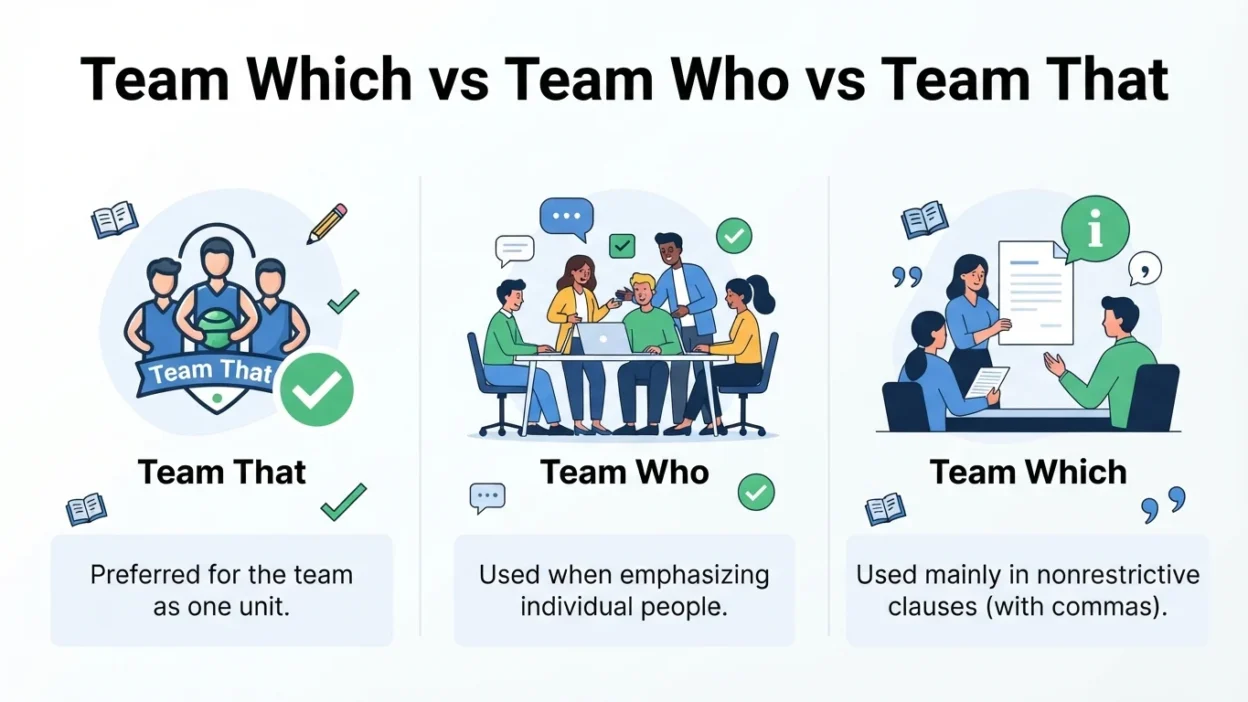
Many English learners struggle with team which vs team who vs team that because all three relative pronouns appear after the word team.
Since a team is made up of people but is also considered a collective noun, choosing the correct pronoun can feel confusing.
The answer depends on whether you’re referring to the team as a single unit or emphasizing the individual members.
Understanding team which vs team who vs team that is important for writing clear and grammatically correct English.
While that is usually the preferred choice in everyday English, who is appropriate when focusing on team members as people, and which is less common in restrictive clauses but acceptable in certain nonessential clauses.
This guide explains the meaning, differences, grammar, examples, and usage so you can confidently choose the right option.
Quick Answer
- Team that is the most common and grammatically preferred choice when referring to the team as one group.
- Team who is used when emphasizing the people within the team.
- Team which is uncommon in American English but may appear in nonrestrictive clauses, especially in British English.
Team Which vs Team Who vs Team That Comparison Table
| Phrase | Grammatically Correct? | Best Use | Common in English |
|---|---|---|---|
| Team that | ✅ Yes | Referring to the team as one unit | Very Common |
| Team who | ✅ Yes | Referring to the members as people | Common |
| Team which | ✅ Limited | Mainly nonrestrictive clauses or British English | Less Common |
What Does “Team That” Mean?
Team that treats the team as a single collective unit.
It is the preferred choice in most American English writing and is commonly used in business, education, journalism, and everyday communication.
Examples
- The team that won the championship celebrated all night.
- We hired the team that completed the project successfully.
- The team that developed the software received an award.
What Does “Team Who” Mean?
Team who emphasizes the individual people within the team instead of the team as a single entity.
This form is common when discussing the members’ actions or qualities.
Examples
- The team who volunteered received recognition.
- The team who solved the problem deserves praise.
- The team who helped us was very experienced.
Although correct, some style guides still prefer team that in formal American English.
What Does “Team Which” Mean?
Team which is less common because which usually refers to things rather than people.
However, it can appear in nonrestrictive clauses or British English.
Examples
- The research team, which was formed last year, published new findings.
- Our football team, which has improved greatly, reached the finals.
Notice the commas. In these examples, which introduces additional information.
Main Difference Between Team Which, Team Who, and Team That
| Team That | Team Who | Team Which |
|---|---|---|
| Refers to the team as one unit | Refers to the individual members | Adds extra information about the team |
| Preferred in American English | Used when emphasizing people | Mostly nonrestrictive clauses |
| Most common choice | Common in speech and writing | Less common overall |
Grammar Rule for Collective Nouns
A team is a collective noun.
Collective nouns can refer to:
- One group acting together
- Individual members acting separately
This distinction affects which relative pronoun sounds most natural.
Grammar Forms Table
| Collective Noun | Preferred Pronoun | Example |
|---|---|---|
| Team | That | The team that won. |
| Team | Who | The team who volunteered. |
| Team | Which | The team, which was formed recently, succeeded. |
| Committee | That | The committee that approved the plan. |
| Staff | Who/That | The staff who assisted us were excellent. |
When Should You Use “Team That”?
Use team that when the team acts as one organization or unit.
Examples
Business:
- The team that completed the project earned a bonus.
Education:
- The team that won the science competition received scholarships.
Sports:
- The team that scored first maintained its lead.
Technology:
- The team that designed the application fixed the issue quickly.
When Should You Use “Team Who”?
Choose team who when highlighting the individuals within the group.
Examples
- The team who volunteered spent the weekend helping families.
- The team who organized the fundraiser deserves recognition.
- The team who answered customer questions received awards.
When Should You Use “Team Which”?
Use team which mainly in nonrestrictive clauses where extra information is added.
Examples
- The design team, which was established in 2020, has expanded rapidly.
- Our robotics team, which won last year, returned stronger this season.
Without commas, which is usually not the best choice in American English.
Real-Life Examples
| Context | Best Choice | Example |
|---|---|---|
| Business | Team that | The team that achieved the sales target earned bonuses. |
| School | Team that | The team that won the debate advanced nationally. |
| Sports | Team that | The team that scored first won the match. |
| Volunteer work | Team who | The team who served meals inspired everyone. |
| Research | Team which | The research team, which included experts worldwide, published the report. |
| Technology | Team that | The team that built the software released an update. |
Why Do People Confuse Team Which, Team Who, and Team That?
Several reasons explain the confusion.
Team refers to people
Because a team consists of people, many writers naturally choose who.
Team is also one unit
Grammar often treats team as a single collective noun, making that appropriate.
British and American English differ
British English is generally more flexible with collective nouns, while American English strongly favors that for restrictive clauses.
Different style guides
Some grammar guides accept both who and that, while others recommend one depending on context.
Professional and Industry Usage
| Industry | Preferred Choice | Reason |
|---|---|---|
| Business | Team that | Refers to one organization |
| Journalism | Team that | Standard editorial style |
| Education | Team that | Formal writing |
| Sports reporting | Team that / Team who | Depends on emphasis |
| Scientific research | Team that | Formal grammar |
| British publications | Team who / Team which | More flexible usage |
Common Mistakes
| Incorrect | Correct |
|---|---|
| The team which won received medals. | The team that won received medals. |
| The team that, which was formed last year, succeeded. | The team, which was formed last year, succeeded. |
| The team who has won its match. | The team that has won its match. |
| The research team which developed the vaccine (US style). | The research team that developed the vaccine. |
Correct Sentences
- The team that solved the issue received praise.
- The team who volunteered made a difference.
- The research team, which included experts from five countries, published its findings.
Memory Trick
Remember this simple rule:
- That = The whole team
- Who = The people in the team
- Which = Extra information with commas
This trick helps you choose the correct relative pronoun quickly.
How to Choose the Right One
| Step | Question | Best Choice |
|---|---|---|
| 1 | Is the team acting as one unit? | Team that |
| 2 | Are you emphasizing individual members? | Team who |
| 3 | Is the clause extra information with commas? | Team which |
| 4 | Are you writing formal American English? | Team that |
| 5 | Are you following British English style? | Team who or Team which (depending on context) |
People Also Ask
Is “team that” correct?
Yes. It is the most common and widely accepted choice, especially in American English.
Can I say “team who”?
Yes. It is correct when emphasizing the people who make up the team.
Is “team which” wrong?
No. It is grammatically correct in certain contexts, especially in nonrestrictive clauses introduced by commas.
Which is best in formal writing?
Team that is usually the safest and most widely accepted option.
Does British English use “team who” more often?
Yes. British English often treats collective nouns as groups of individuals, making who more common.
Frequently Asked Questions
Which is the most common phrase?
Team that is the most common in formal and everyday American English.
Why is “team who” sometimes used?
Because the speaker wants to emphasize the individual people in the team.
Should I use “which” without commas?
Usually no. In American English, that is preferred for restrictive clauses.
Can all three be grammatically correct?
Yes, but each has different usage depending on context and style.
Which should I use in business writing?
Use team that because it is the clearest and most widely accepted choice.
Conclusion
Understanding team which vs team who vs team that becomes much easier once you recognize that team is a collective noun. If you’re referring to the group as a single unit, team that is the preferred and most common choice, especially in American English. If you want to highlight the individual members, team who is perfectly acceptable. Team which is mainly reserved for nonrestrictive clauses that add extra information, particularly in British English.
When you’re unsure, remember the simple rule: use “team that” for the group, “team who” for the people, and “team which” only for additional information introduced by commas.